
From News Deserts to Nonprofit Resilience:
Assessing the Health of Washington’s Local News Ecosystem
Jennifer R. Henrichsen, Pawel Popiel, Elizabeth Chambers, Alexandra Fil, Kathryn Robinson-Tay, Lisa Waananen Jones, Joanne Lisosky, Ryan J. Thomas, Jody Brannon, Ben Shors
Executive Summary
Journalism, and local news in particular, has long been considered critical to an informed and engaged citizenry and an important foundation for a robust democracy. Yet over the past couple of decades, local news across the United States has rapidly shrunk in both quantity and quality. The roots of the local news crisis stem from intersecting financial challenges, including revenue losses, rising costs, and ownership consolidation. News outlets find it difficult to recruit and retain local journalists because of low wages and financial insecurity. Audiences that news outlets rely on for revenue appear to avoid the news, distrust the media, have low media literacy, and tend to consume misinformation from social media sites. Technological challenges persist, including a slowness to respond to technological change and reliance on Big Tech for advertising dollars to help news outlets stay afloat.
The consequences of this crisis are severe, including decreased civic engagement and participation, decreased government transparency and accountability, increased low-quality information, and loss of social cohesion among community members as local news outlets close.
As the situation worsens nationally, with dire implications for democracy, we carried out the most comprehensive assessment of Washington’s local news ecosystem to date. This report, From News Deserts to Nonprofit Resilience: Assessing the Health of Washington’s Local News Ecosystem, builds on local news scholarship nationally and aims to provide policymakers, journalists, and all who call Washington home with a practical assessment of the health of the state’s local news ecosystem.
To these ends, we first created a comprehensive database of Washington local news outlets using open source data and found 1,092 outlets to examine for inclusion. To supplement the database, we disseminated a survey to local news organizations, and interviewed 32 civic leaders, journalists, editors, publishers, and journalism scholars with expertise in local news.
We excluded a significant number of news sites from our database because they either lacked a web presence and thus could not be evaluated or did not meet our locality or content quality criteria. The 353 outlets that remained met our criteria, offering the most comprehensive map of the state’s local news industry to date.
We collected data about key characteristics of these news outlets, including outlet ownership, publication frequency, and annual operating budget. We analyzed ownership structure because prior research has shown that it is an important determinant of newsroom sustainability, the ability to provide quality coverage responsive to local communities, and audience trust in the news media.
Given the continuously shifting local news landscape, this report represents a snapshot based on data collected and analyzed between November 2023 and December 2024. As the most comprehensive ecosystem mapping project in Washington to date, this report provides key insights on challenges and opportunities facing local news in the state. Our findings also serve as an essential foundation for addressing more complex research questions, including how Washingtonians are engaging with (or avoiding) news and whether their critical information needs are being met.
The report begins by introducing the local news crisis facing the nation and the importance of studying Washington. It then provides an in-depth map and analysis of the local news ecosystem in Washington. Next, it presents insights from journalists, civic leaders, and scholars about key opportunities and challenges facing local news before providing an overview of initiatives around the nation that support local news and which local organizations and policymakers could draw inspiration from. Finally it concludes with recommendations for policymakers, civic leaders, and journalists, to bolster the health of local news in Washington state.
The report includes several key takeaways:
- This is the most comprehensive report on local news in Washington to date, revealing that Washington is not immune to the local journalism crisis embroiling the nation.
- Less populous, rural areas are particularly lacking in news outlets as are some denser urban areas when factoring in their population density. Our analysis suggests, in line with prior research,1 that as a consequence marginalized and low-income communities may be the most disadvantaged in terms of local news.
- Assessing the presence of local news outlets across the state reveals a significant absence of media diversity which is essential to a robust and democratic media system. We found two counties with no news outlets meeting our criteria and five counties with only one news outlet.
- The majority of the state’s counties fall below the state county average of news outlets per capita, indicating that outlets are unevenly distributed around the state and suggesting the need for capacity building support.
- Despite being hard hit, newspapers remain the most common type of news outlet in Washington, followed by online-only outlets. Radio, television, and magazines also comprise important components of Washington’s ecosystem.
- A majority of Washington’s local news outlets are single companies and tend to be private family-owned companies, nonprofits, and locally or community-owned organizations. These are ownership types that are most likely to produce locally situated news coverage. We also find that nonprofit and locally owned outlets tend to have smaller budgets, but more consistent publication frequency. Despite this, nearly one-third of Washington’s news outlets belong to national chains.
- A significant proportion of outlets have an annual operating budget of less than $250,000, which indicates small staffs, diminished operational expenditures, and resource constraints related to news production capacity.
- Interviewees, including journalists, editors, publishers, civic leaders, and scholars, characterize the local news situation in Washington as in crisis, with reduced local news coverage, including civic and political news, as a result of staffing and budget reductions. Revenue losses, rising costs, and news ownership consolidation have compounded local news outlets’ financial and capacity concerns.
- Interviewees shared a deep concern about the future of local news and how its decline impacts democratic society, including:
- reduced information to voters, resulting in a less informed citizenry
- decreased civic engagement, participation, and social cohesion
- reduced accountability of government agencies and authorities
- increased political polarization
- Interviewees note that inadequate compensation makes it difficult for news organizations to retain journalists and recruit future ones, contributing to a less diverse workforce and revealing multiple cracks in the journalism workforce pipeline. These cracks in the pipeline are forcing a growing reliance on contingent laborers, including freelancers and volunteers.
- Interviewees acknowledge the need for public support, including initiatives, legislation, training programs, and funding from a variety of entities–from state and federal government to philanthropic, and civic organizations–to bolster local journalism.
- Despite the myriad challenges facing local journalism, interviewees highlight potentially promising opportunities for news organizations to diversify revenue streams through direct donations, local business support, foundation grants, and state initiatives; leveraging technologies and embracing new strategies to reach expanded audiences; and increasing collaboration among journalists and news organizations to cover stories in a resource-strapped environment.
We draw on these findings to provide recommendations to policymakers, philanthropic and community organizations, and journalists (see the Conclusion for a comprehensive list of recommendations). Policymakers interested in the future of journalism could strengthen the health of Washington’s local news ecosystem through direct subsidies, tax credits, and legal mechanisms that bolster press freedom. Philanthropic and community organizations could invest in funding local journalism education programs to strengthen the journalism workforce pipeline and improve media literacy efforts. Journalists could continue to take advantage of philanthropic and state funding opportunities and participate in local journalism research.
At the same time, this research provides a snapshot in a rapidly changing landscape. We acknowledge our data may contain some omissions or errors as we sought to develop the most comprehensive local news database in Washington to date. Additionally, although our database criteria for inclusion (regularly producing local, original, and journalistic coverage and based in Washington or serving a Washington community) are robust, this report does not differentiate between outlets that almost exclusively report original news and those that offer some original news on a regular basis. We encourage news outlets to contact us as the landscape changes so we can update our database to reflect these shifts. This will also help us capture the evolving landscape of local news in Washington.
Acknowledgements
First, we would like to thank the journalists, editors, and publishers who took time out of their busy schedules producing news for the public to answer our survey questions, which have helped inform this report. We would also like to thank the civic leaders, journalists, editors, publishers, and scholars who agreed to be interviewed about the state of local news in Washington.
Additionally, we would like to express our appreciation for the assistance of Washington State University’s Center for Interdisciplinary Statistical Education and Research (CISER) for statistical analysis and the Social & Economic Sciences Research Center (SESRC) for survey design and sample management.
Thank you, also, to the scholars who gave feedback on our research project at the March 2024 Local News Researchers Workshop at Duke University and at the Association for Education in Journalism and Mass Communication’s (AEJMC) annual conference in August 2024, and to the scholars and practitioners involved in the Local News Impact Consortium for our generative conversations about local news. Finally, our special thanks to Dr. Benjamin Toff of the University of Minnesota-Twin Cities and Dr. Regina Lawrence of the University of Oregon, who shared insights from their own state mapping projects and reviewed prior drafts of the report.
Suggested Citation
Henrichsen, J.R., Popiel, P., Chambers, E., Fil, A., Robinson-Tay, K., Waananen Jones, L., Lisosky, J., Thomas, R.J., Brannon, J., & Shors, B. (2025, March). From News Deserts to Nonprofit Resilience: Assessing the Health of Washington’s Local News Ecosystem. The Edward R. Murrow College of Communication. Washington State University. Pullman, WA.
Date of publication: March 2025
[1] Timothy Neff, Pawel Popiel, and Victor Pickard, “Philadelphia’s News Media System: Which Audiences Are Underserved?” Journal of Communication 72, no. 4 (2022): 476-487, https://doi.org/10.1093/joc/jqac018; Nikki Usher, News for the Rich, White, and Blue: How Place and Power Distort American Journalism (New York City: Columbia University Press, 2021).
1. Introduction: The Local News Crisis Facing the Nation
Local journalism is experiencing an accelerating decline across the U.S., with alarming implications for communities across the country. Local newspapers provide more original news coverage than any other medium or format yet are closing at a rate of two per week, an increase from previous years.2 The U.S. has lost more than one-third of its local newspapers and nearly two-thirds of its journalism jobs since 2005.3 While studies have found that this decline has predominantly affected rural and politically conservative areas,4 recent research has shown that the decline extends to urban areas.5 The U.S. has also seen a decline in the quantity and quality of political news coverage, which is essential for citizen engagement.6
In the information vacuum left by diminished and disappearing legacy media, the growth of alternative media such as digital-only websites, ethnic media organizations, and public broadcasting stations has been modest, failing to replace previous losses.7 Instead, low-quality information sources have proliferated. These include so-called “pink slime” sites, opaquely funded websites that masquerade as local news outlets while typically promoting algorithmically generated partisan content that possess little factual information or local relevance.8
This has dire consequences. Without adequate access to quality local news, communities’ critical information needs – that is, information about essential topics including emergencies, health, and politics – go unmet.9 Past research has shown that civic and political participation decreases in communities without access to substantial political news.10 Voters are less engaged in communities without a newspaper.11 Further, the uneven decline of local news exacerbates existing socioeconomic and racial inequities and may increase political polarization as legacy media outlets retreat from rural, politically conservative areas but survive in urban, liberal ones.12 Local journalism is also essential for fostering a sense of community identity and cohesion.13
[2] Penelope Muse Abernathy and Sarah Stonbely, “The State of Local News: The 2023 Report,” Local News Initiative, accessed December 10, 2024, https://localnewsinitiative.northwestern.edu/projects/state-of-local-news/2023/report/.
[3] Abernathy and Stonbely, The State of Local News.
[4] Usher, News for the Rich, White, and Blue.
[5] Benjamin Toff, “Minnesota’s Local News Ecosystem Report 2024,” Minnesota Journalism Center Ecosystem Mapping Project, September 27, 2024, https://newsmap.umn.edu/minnesotas-local-news-ecosystem-report-2024
[6] Danny Hayes and Jennifer L. Lawless, “The Decline of Local News and Its Effects: New Evidence from Longitudinal Data,” The Journal of Politics 80, no. 1 (2018): 332–336. https://doi.org/10.1086/694105.
[7] Abernathy and Stonbely, The State of Local News.
[8] Asa Royal and Philip M. Napoli, “Local Journalism Without Journalists? Metric Media and the Future of Local News,” Journal of Creative Industries and Cultural Studies-JOCIS 8 (2022): 119–147, https://jocis.org/2022/12/27/local-journalism-without-journalists-metric-media-and-the-future-of-local-news.
[9] Lewis Friedland, Philip Napoli, Katherine Ognyanova, Carola Weil, and Ernest J. Wilson III, Review of the Literature Regarding Critical Information Needs of the American Public (Washington, D.C.: Federal Communications Commission, 2012), http://transition.fcc.gov/bureaus/ocbo/Final_Literature_Review.pdf.
[10] Hayes and Lawless, “The Decline of Local News and Its Effects.”
[11] Dee Anne Finken, Delores Irwin, Sally Carpenter Hale, Linda Hughes, Joanne Lisosky, Carol Rikerd, Lauren Snider, Lyn Whitley, and Sharon Wilhelm, “The Decline of Local News and Its Impact on Democracy” (Seattle, Washington: The League of Women Voters of Washington Education Fund, 2022), https://www.lwvwa.org/resources/Documents/Studies/LocalNews/Decline%2036.pdf.
[12] Usher, News for the Rich, White, and Blue.
[13] Masahiro Yamamoto, “Community Newspaper Use Promotes Social Cohesion,” Newspaper Research Journal 32, no. 1 (2011): 19–33, https://doi.org/10.1177/073953291103200103.
2. The Importance of Studying Washington
Given the challenges facing local journalism nationally, state-level studies about the health of local news ecosystems provide valuable insight into where support is needed.14 A comprehensive assessment of local news in Washington is particularly important given that it is a large and diverse state but with relatively little past research investigating how its population is served by its media system. Additionally, renewed state interest in supporting local news in Washington means the time is ripe for determining where and how resources can be used most effectively.
Nestled in the beautiful Pacific Northwest, Washington is considered a gem for its rugged mountains and coastal cities on the west side of the state and its rolling hills and fertile farmland along the Palouse to the east. This rich geography reflects the topographic diversity of the state, with large, dense and progressive metropolitan areas in the west, and sparse, rural, and more conservative areas on the east side of the state.
Washington is one of the wealthiest states and regularly ranks among the top for doing business as well as for workers’ rights.15 U.S. News and World Report has identified Washington as a top 10 state overall for several years running, and it has been celebrated as one of the best for affordable health care, need-based higher education financial aid packages, high minimum wage, and good air quality.16
However, like other states, Washington faces challenges, including crime, substance misuse, and lack of affordable housing. In 2023, Washington experienced 31,208 violent offenses,17 5,022 arrests for drug-related offenses,18 and a doubling of deaths related to opioid use compared to past years.19 Additionally, the average cost of a home in Washington is $613,00020 and the average cost of rent is $1,682 per month,21 which has made finding affordable housing difficult, and out of reach for some potential residents.
Local news is essential to Washington’s ability to tackle the challenges it faces and thrive as a state because it provides citizens with civic knowledge that is a precursor for robust interest and engagement in community life. Studying Washington’s local news ecosystem provides insight into where nearly eight million Washingtonians get their local news and also whether Washingtonians have access to reliable news in the first place.
Washington is also home to a major, economically thriving technology industry. The state exceeds the national average for high-speed internet access, with 93% of households having broadband subscriptions22 and the ability to access local news online. The presence of major tech companies like Microsoft, Amazon, and Google, several of which serve as key distribution channels for the state’s local news, could provide fertile ground for innovation that could help local news outlets.
Washington’s population is primarily White (76.3%), although there are substantial Asian (10.8%) and Hispanic/Latino (14.6%) populations.23 There is a significant presence of American Indian tribes, including 29 that are federally recognized.24 Additionally, 49.6% of the population is female, and 92.2% hold a high school diploma or higher.25 Washington’s primary political party affiliation is Democrat, with 52.34% registering as Democrat and 28.26% registering as Republican as of 2024.26 Washington’s diverse demographics suggest that a press that reflects the state’s pluralism and mix of cultures is valued. Because of the diverse makeup of the state, our findings could reflect some local news challenges facing other states, and this report’s recommendations could help to serve other U.S. regions.
Need for Local News Research in Washington
Despite a compelling need to study local journalism in the state, few studies have examined Washington’s local news landscape. Nationally, most local news ecosystem research published in the past five years focuses on the East Coast and Midwest.27 A nationwide study of local news conducted by Northwestern University’s Medill School includes Washington but without comprehensive information.28
A small number of studies conducted by Washington organizations include the League of Women Voters of Washington’s 2023 report about the decline of Washington newspapers and its effect on public life and Washington State University’s 2012 Murrow Information Initiative report about the unmet information needs of rural areas.29 While both make valuable contributions to understanding Washington’s local news landscape, further research is needed to present a current and comprehensive picture of local news outlets, including newspapers, broadcast media, and digital sites, as well as resources at their disposal.
This report builds on and significantly elaborates upon these studies by striving to comprehensively map the state’s local news ecosystem. It also fulfills a need to conduct state-level local news ecosystem research in under-studied areas of the U.S., and to develop and employ consistent research methods to facilitate regional comparisons.30 In this spirit, we modeled much of our approach on a 2023 report analyzing the local news ecosystem of Oregon.31
A final reason to study local news in Washington is to inform policymaker interest in supporting local journalism in the state.
The Washington State Legislature has pursued several initiatives to bolster local news. In 2023, the legislature appropriated $2.4 million to support the development of the Murrow News Fellows Program, which helps news organizations across the state bolster civic news coverage in underserved communities, thereby bolstering the journalist labor pool pipeline and newsroom capacities. Many local news outlets across the country, including in Washington, lack the resources to hire and retain journalists at a competitive rate. The fellowship program aims to alleviate that financial pressure by pairing promising early career reporters with Washington news organizations, funding their salary for two years so they can report on civic affairs and bolster critical information needs.32 As part of the fellowship program, journalists receive ongoing training resulting in a certificate in digital media, and the Murrow College provides an annual report on the program. This funding also helps to support the development of this local news ecosystem report.
Additionally, in 2023 the legislature passed a bill (which was signed into law by Gov. Inslee) to provide a business and occupation (B&O) tax exemption for newspaper publishers and printers, replacing the previous preferential B&O tax rate enacted in 2009.33 This tax exemption intends to reduce economic pressures on local news outlets and to help preserve their ability to publish. This report will identify other potential mechanisms of state support for local news in Washington.
[14] “Local news ecosystem” is a common term to describe news sources in a given geographic area. While ecological metaphors for news media originated a century ago, the concept of a “news media ecosystem” has gained popularity as a way to describe dynamic and interconnected digital sources of information. We also use the terms journalistic infrastructure and news production capacity to describe resources available to local news sources. See Anthony Nadler, “Nature’s Economy and News Ecology: Scrutinizing the News Ecosystem Metaphor,” Journalism Studies 20, no. 6 (2019): 823–839, https://doi.org/10.1080/1461670X.2018.1427000, and Regina Lawrence and Courtney Tabor, “Measuring the Health of Local News Systems” (paper presentation, American Political Science Association Conference, Los Angeles, California, September 2, 2023).
[15] Steven Ross Johnson, “The 10 Wealthiest States in the U.S.”, U.S. News & World Report, December 27, 2024, https://www.usnews.com/news/best-states/slideshows/10-wealthiest-states-in-america?slide=5; Washington Governor Jay Inslee, “Economy,” accessed December 10, 2024, https://governor.wa.gov/issues/economy.
[16] Inslee, “Economy”; Daniel Schrager, “WA Is One of the States with the Highest Quality of Life, CNBC Says. Here’s Where It Ranks,” Bellingham Herald, July 15, 2024, https://www.bellinghamherald.com/news/state/washington/article290088244.html.
[17] Tonya Todd, Brent Gibson, and Joan Smith, The Crime in Washington 2023 Annual Report, (Lacey, Washington: Washington Association of Sheriffs and Police Chiefs, 2023), https://waspc.memberclicks.net/assets/Crime%20in%20Washington%202023-compressed.pdf.
[18] Todd, Gibson, and Smith, Crime in Washington.
[19] Washington State Department of Health, “Opioid Data,” accessed December 10, 2024, https://doh.wa.gov/data-and-statistical-reports/washington-tracking-network-wtn/opioids.
[20] “Median home price in Washington,” Washington State Office of Financial Management, accessed on December 20, 2024, https://ofm.wa.gov/washington-data-research/statewide-data/washington-trends/economic-trends/median-home-price.
[21] United States Census, “Quick Facts: Washington,” 2023, https://www.census.gov/quickfacts/fact/table/WA/PST045223.
[22] Census, “Quick Facts.”
[23] Census, “Quick Facts.”
[24] Washington Tribes, Washington Indian Tribes Today: Preserving Culture, Enriching People, Sustaining the Environment, and Building Community (Olympia, Washington: Washington Tribes, 2020), https://www.washingtontribes.org/wp-content/uploads/2020/10/Final-2020_WA_Indian_Tribes_Today.pdf.
[25] Census, “Quick Facts.”
[26] Independent Voter Project, “State-By-State Voter Registration Statistics,” October 1, 2024, https://independentvoterproject.org/voter-registration-by-state.
[27] Lawrence and Tabor, “Measuring the Health of Local News Systems.”
[28] Abernathy and Stonbely, The State of Local News.
[29] Finken et al., The Decline of Local News; Brett Atwood, Michael Beam, Douglas Blanks Hindman, Elizabeth Blanks Hindman, Lawrence Pintak, and Ben Shors, The Murrow Rural Information Initiative: Access, Digital Citizenship and the Obligations of the Washington State Information Sector (Pullman, Washington: Washington State University, 2012), http://mediad.publicbroadcasting.net/p/nwpr/files/201206/Murrow%20FCC%20Rural%20Information%20Initiative%20Final%20Report.pdf.
[30] Lawrence and Tabor, “Measuring the Health of Local News Systems.”
[31] Regina Lawrence, Courtney Tabor, Michelle Nicolosi, and Andrew DeVigal, Assessing Oregon’s Local News & Information Ecosystem Connecting News, Information, and Civic Health (Eugene, Oregon: University of Oregon, 2022), https://agorajournalism.center/newsecosystem22/.
[32] Edward R. Murrow College of Communication, “Murrow News Fellowship,” accessed December 10, 2024, https://news-fellowship.murrow.wsu.edu/.
[33] Washington House of Representatives, E2SSB 5199: An Act Relating to Tax Relief for Newspaper Publishers, April 17, 2023, https://lawfilesext.leg.wa.gov/biennium/2023-24/Pdf/Bill%20Reports/House/5199-S2.E%20HBR%20APH%2023.pdf?q=20241113214331.
3. Mapping Washington’s Local News Ecosystem
This report provides a comprehensive assessment of the state of Washington’s local news ecosystem in 2024. To map the local news ecosystem, we engaged in a three-step process, as shown by Figure 1.
First, we used publicly available information to create a comprehensive database of Washington’s local news outlets, as overviewed in this section. Second, we supplemented the database with a survey of local news outlets, presented in the next section: Section IV. An Analysis of Washington’s News Ecosystem. Finally, we interviewed journalists, scholars, and civic leaders who are knowledgeable about local news in Washington to gain on-the-ground perspectives about challenges and opportunities facing the industry, as presented in Section V: Local News and Civic Engagement in Washington: Insights from Journalists, Civic Leaders, and Scholars. Using data from multiple sources and employing quantitative and qualitative methods allows us to present a more holistic picture of the health of the ecosystem.
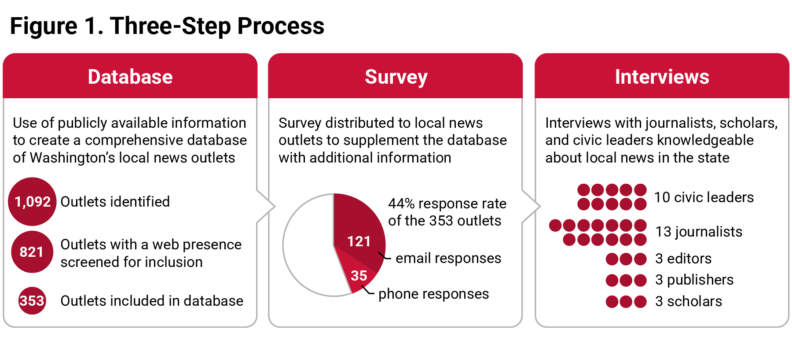
As first steps, we created a comprehensive database of Washington’s local news outlets. We identified potential outlets using publicly available sources, including state press association member lists, government databases, and other resources (see Appendix A for the full methodology).
Next, we screened outlets for inclusion in the database based on criteria designed to determine whether outlets are “local” to Washington and provide minimum-quality local news content. Not all outlets located in Washington aim to serve Washington communities, and sometimes outlets located outside of the state serve Washington residents. Additionally, not all news outlets that aim to serve Washington communities produce local news content.
To be considered local, we required that outlets must be either a) located in Washington and primarily oriented to a Washington community or b) located outside of Washington but primarily oriented to a Washington community.34 Certain outlets were based out of state, but adjacent to Washington. These outlets were included if they were determined to serve a primarily Washington audience, typically in the county geographically proximate to the outlet’s location. For instance, the Moscow-Pullman Daily News is located in Moscow, Idaho, but one of its primary audiences is Pullman, Washington, eight miles away. We also acknowledge that while an outlet might be geographically based in a specific county, its readership or viewership could extend into other counties.
Additionally, to ensure that included outlets published local news, we only included organizations that a) regularly publish substantial content on a website or social media page that is b) original, c) journalistic, and d) locally relevant (see Appendix A for more details about the inclusion criteria).35 Two members of our research team checked outlet addresses and performed a basic content analysis on one month of online content from each outlet to determine if outlets met the inclusion criteria.
Initial identification of outlets for the database yielded 1,092 potential local news sources. Of these, 821 outlets had a web presence and were screened for inclusion in the database. The screening process resulted in a total of 353 outlets remaining to include in the database as of December 2024. Most of the excluded outlets were rejected due to a lack of recent or locally relevant content. In a few cases, outlets were excluded because the content was not original (i.e., it was not created by the newspaper staff) or journalistic.36
Once we determined which outlets to include in the database, we used publicly available sources to collect the following specifics about included outlets: medium type, address, county, region, year founded, publication frequency, audience size, specific community served (e.g., Spanish language), owner, ownership type, newsroom staff size, and website and social media URLs. Collecting this information from public sources proved challenging in some cases, prompting us to develop a survey for local news outlets (See Appendix B: Description of Survey Method and Appendix C: Survey Questionnaire (Phone Version)).
We also collected publicly available data about county demographics and political behavior to assess which Washington regions and communities are underserved by local news providers. This included population density, median household income, poverty rate, race and ethnicity, political participation, and other factors obtained from the U.S. Census and Washington Secretary of State data. In this iteration of the report, we primarily utilize the population density data, but in future reports, we intend to analyze more of these characteristics in conjunction with the concept of news production capacity, or the ability of a news outlet to serve quality local news to its community, by examining an outlet’s operating budget (e.g., ability to fund staff, news production, etc.), its editorial staff levels (i.e., its ability to cover beats and produce news stories) and its publication frequency (i.e., the consistency of its news production). Additionally, we anticipate conducting an in-depth content analysis of news organizations’ coverage to assess which outlets best meet the critical information needs of Washingtonians.
The next section dives into our analysis of the quantitative data collected in the database and from the survey to inform our understanding of the local news landscape in Washington.
[34] Adapted from Napoli et al., “Local Journalism.”
[35] Adapted from Lawrence et al., Assessing Oregon’s Local News, and Napoli et al., “Local Journalism.”
[36] Original content means that the outlet has published content (i.e., at least one article, video, or audio clip) that was created by the outlet’s staff (based on a byline) rather than by another outlet located outside the community (e.g., wire or syndicated content) or another organization (e.g., a press release, reposting of content from another website). Journalistic content means that the outlet has published content (i.e., at least one article, video, or audio clip) that is “a ‘reported’ story, meaning the content creator gathered information from spokespersons, experts, documents and other sources and attributed information in the story to those sources” (Lawrence et al., 2022, p. 69).
4. An Analysis of Washington’s Local News Ecosystem
In this section, we document the state of local news in Washington through a quantitative analysis of data from our local news outlet database and survey.
To preface our analysis, Washington’s local news ecosystem has experienced numerous changes since the League of Women Voters of Washington published its important 2022 report on declining local journalism in the state. Multiple Washington newspapers have closed or merged. For example, the Skamania Observer closed in October 2023, the Grant County Journal shuttered in June 2023, and the Davenport Times merged with the Odessa Record in March 2022.
Sound Publishing, a major player in the state’s media landscape for more than three decades which operates more than 40 outlets in Washington and Alaska,37 was sold via its parent company, Black Press Media, to Carpenter Media in March 2024. The acquisition expanded Carpenter Media’s national presence, including in nearby Oregon, and impacted Washington news outlets, including significant layoffs at the Everett Herald, two months after the sale.38
At the same time, new publications have emerged, such as Gig Harbor Now, founded in 2021, and Bellingham’s Cascadia Daily News in 2022.39 The state also has more nonprofit newsrooms with the conversion of My Neighborhood News Network to a nonprofit (covering the Snohomish County communities of Edmonds, Lynnwood and Mountlake Terrace) and the creation of Washington State Standard, part of the States News Service, in 2023.40 Dedicated to news coverage of state government, the Standard is part of the States Newsroom, the largest state-focused nonprofit news organization in the U.S. with a presence in all 50 capitals.41 It arrived during a drought of full-time reporters in Olympia and an unsuccessful 2024 effort by the Allied Daily Newspapers of Washington and the Washington State Association of Broadcasters to create an Olympia bureau dedicated to state government.42 The Murrow News Fellows program placed three six-month fellows in Olympia for the 2025 legislative session,43 in addition to the 16 two-year fellows serving 22 newsrooms statewide, each providing civic affairs coverage.
With this context in mind, we examine the current local news landscape in Washington, including key characteristics, between November 2023 and December 2024.
Characteristics of Washington’s Local News Outlets
In this section, we identify the number of outlets in each county and note their key characteristics, including how they differ by medium, ownership type, ownership structure, and publication frequency.
Figure 2: Washington State Regions, is modeled after Philanthropy Northwest’s map, and associates various factors to group counties into nine regions.
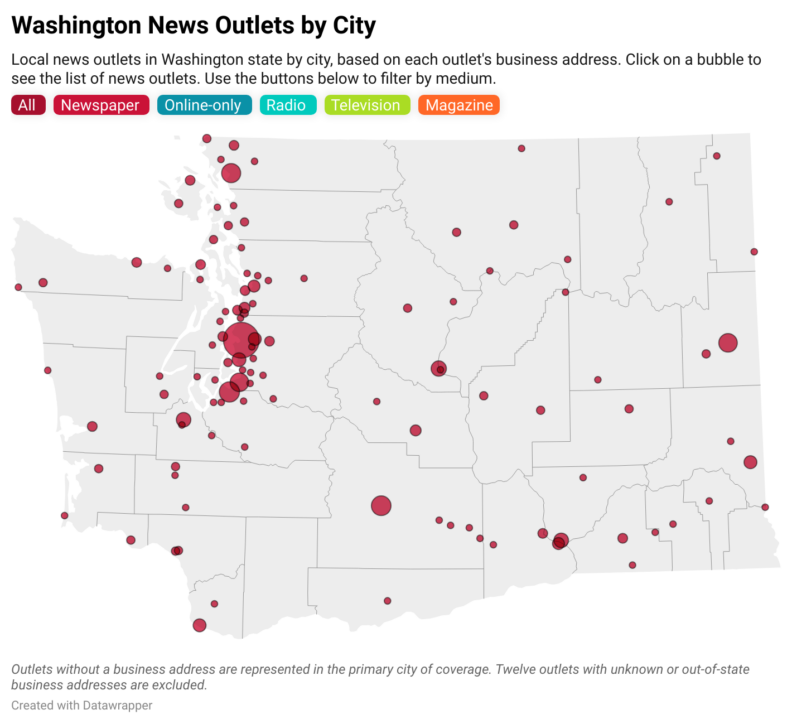
Where Washington’s news outlets are located. The 353 outlets determined to produce regular local news (based on the criteria outlined in Appendix A) are in 37 of 39 counties. No news outlets fitting our inclusion criteria were present in Skamania County in the Southwest Region or in Ferry County in the Northeast Region. Five counties only had one outlet each: Adams, Columbia, Garfield, Lincoln, and Stevens counties. Five had two outlets: Douglas, Island, Pacific, Pend Oreille, and Wahkiakum counties. Overall, then, twelve counties out of 39 (or 30.76%) have two or fewer outlets per county. Figure 3: News Outlets by County, shows the number of outlets per county across the state.
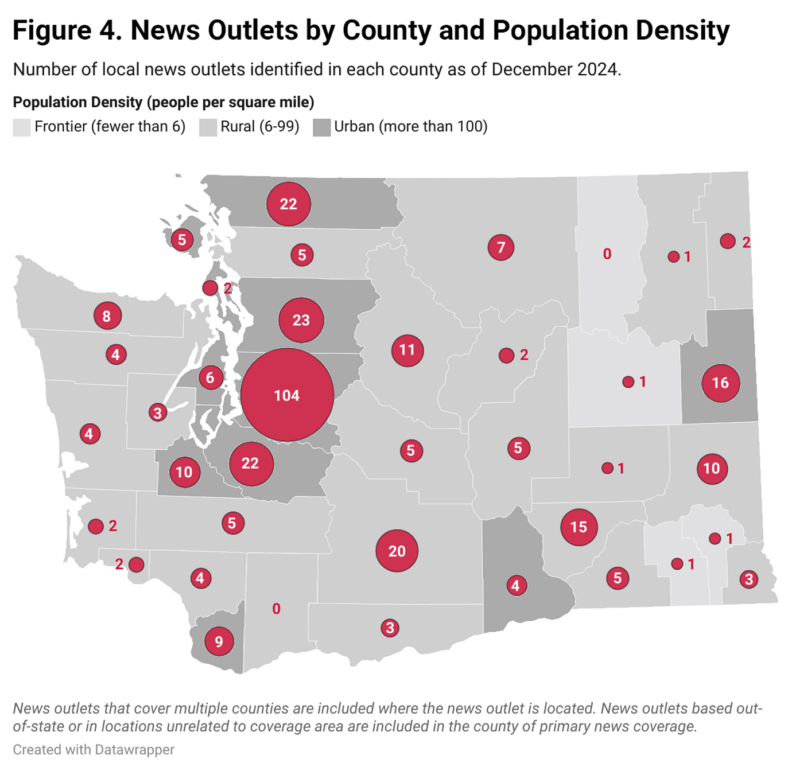
We then accounted for population density when examining the number of outlets per county. Figure 4: News Outlets by County and Population Density, consists of two layers. The county-level population density is revealed by the grayscale, which categorizes counties as frontier, rural, or urban. These classifications come from a 2022 report on local Oregon outlets,[44] adapted from the Oregon Health and Science University and the Oregon Office of Rural Health.[45] Frontier counties have fewer than 6 residents per square mile, rural counties have 6 to 99 residents per square mile, and urban counties have more than 100 residents per square mile. We include this layer in the map to show how the density of county-level population aligns (or does not align) with the density of news outlets in a given county.
The second layer shows the number of outlets per county. News outlets that cover multiple counties are included in the county where the news outlet is located. News outlets based out of state (but which serve Washington residents and thus fit the locality criteria) or are in locations unrelated to coverage area are included in the county of primary news coverage.
The map reveals how local news outlets are unevenly distributed across the state, with more outlets generally associated with urban counties, followed by those categorized as rural and frontier, which typically have lower population density. For example, we find that three outlets are located in frontier counties, 127 outlets in rural counties, and 223 outlets in urban counties. The data also show how 12 counties are served by two or fewer outlets, which means that if an outlet closes in these counties, the impact on the community would likely be more significant than in a county with numerous outlets.
Individual news outlets constitute the state’s journalistic infrastructure, and to assess how well this infrastructure serves Washington’s residents we calculated the number of outlets in each of the state’s regions and counties. To facilitate comparisons across regions, we standardized the sum of outlets to 100,000 residents per region. For county-level comparisons, we calculated the sum of outlets per 10,000 residents per county. Additionally, we calculated the average number of outlets per region and county to establish a threshold for comparing which regions and counties are more (higher than average) or less (lower than average) served by the state’s journalistic infrastructure.
Since counties with larger populations are likely to have more news stories to cover than counties with smaller populations, our outlet per capita sums attempt to capture the relative work outlets in a given county must do to cover their residents. In other words, these outlet per capita sums denote the work an average outlet does to cover its respective county’s population (e.g., one outlet serving a county with a population of 1,000 represents the work of ten outlets serving a county with a population of 10,000).[46]
Our geographic analysis of outlet data reveals that several Washington regions and counties are underserved (i.e., lacking access to local news) by the state’s local news ecosystem. Figure 5: Outlets per 100,000 Residents by Region shows that, on average, the state’s least populous regions (e.g., Southeast, North Central, and Northwest) are best served by local news outlets, when adjusted for population. In a surprising finding, that runs contrary to expansive literature on news deserts as primarily present in rural or sparse areas, one of Washington’s most dense and urbanized regions, Southwest, is least well served by local news outlets, with 2.3 news outlets per 100,000 residents.[47] Future research will try to obtain a more detailed understanding of news outlets’ news production capacity or the ability of a news outlet to serve quality local news to its community, by examining an outlet’s operating budget (e.g., ability to fund staff, news production, etc.), its editorial staff levels (i.e., its ability to cover beats and produce news stories) and its publication frequency (i.e., the consistency of its news production).
As Figure 6: Outlets per 10,000 Residents by County shows, 25 counties in Washington fall below the state’s county average, suggesting that 64.1% of the state’s counties have limited media diversity. Clark County, the state’s fifth most populous county, is most underserved by Washington’s local news ecosystem. With 0.17 outlets per 10,000 county residents, Clark County has less than one-fifth the news outlets of the state’s county average (M = 0.97). On the other side of the spectrum, Wahkiakum County, one of the least populous counties, is well served by comparison, with 4.2 outlets per 10,000 county residents or four times the state’s county average. Even then, Wahkiakum County faces precarity if one outlet were to close because it has two news outlets for 4,800 people. Additionally, Wahkiakum County is within the Southwest Region, which is least well served by local news outlets, when adjusted for population, as identified above.
Types of local news outlets across the state. Our database reveals that newspapers (print only or digital and print) comprise 42% (n=149) of news outlets in Washington (as defined by the criteria above and in Appendix A). Online-only outlets comprise 24.65% (n=87) of the outlets in our database. Radio outlets accounted for 19.6% (n=69) of the state’s local news outlets, followed by TV at 9.4% (n=33) and magazines at 4.3% (n=15). The types of local news outlets across the state are visualized in Figure 7: Local News Outlets by Medium Across the State.
Frequency of publication. Just under half of Washington’s news outlets publish or broadcast content daily (48.2%; n=170) and 28.3% (n=100) publish weekly. The prevalence of dailies and weeklies reflects the prominence of newspapers, online only outlets, and radio within the state’s local news ecosystem. This breakdown reveals that fewer than half of all the news outlets in Washington generate consistent, daily local news coverage, likely due to a lack of capacity to do so. The remaining publication frequencies included other monthly, biweekly (every two weeks), semi-weekly (twice per week), triweekly, and “it varies”[48] as shown by Figure 8: Frequency of Publication Among Outlets.
Ownership type. News outlets’ ownership structures are important determinants of newsroom sustainability, the ability to provide quality news coverage responsive to local communities, and audience trust in news media.[49] We identified the ownership type of all 353 outlets in our final database by looking at each outlet’s website, by searching the internet for the information, and by surveying news outlets for ownership information.[50]
We categorized ownership into five types, as shown by Figure 9: News Outlets by Ownership Type.
- Privately owned by hedge fund or non-journalism company (e.g., The Olympian, owned by McClatchy and managed by Chatham Asset Management)
- Privately owned by media company (e.g., KIMA Action News owned by Sinclair Broadcast Group)
- Privately owned by family (e.g., the Yakima Herald-Republic owned by The Seattle Times Company)
- Locally or community-owned (e.g., the Yakama Nation Review owned by Yakama Nation)
- Non-profit (e.g., KNWY-FM 90.3 owned by Washington State University)
Ownership Structure. We also identified the ownership structure of news outlets, namely whether an outlet belongs to a chain or is a single company, using three categories:
- National chain (i.e., multiple media holdings beyond one state to other states)
- Regional chain (i.e., multiple media holdings within Washington state)
- Single company (i.e., single media outlet within Washington state)
As Figure 10: Number of News Outlets by Ownership Structure illustrates, a majority (42%; n=148) of Washington’s local news outlets are single companies, situated in and reporting on communities within the state. Nearly one-third (32%; n=111) of Washington’s news outlets belong to national chains that extend beyond the state’s borders, and one quarter (26%; n=93) belong to regional media chains within Washington. The data exclude one outlet with an unknown ownership structure
Figure 11: News Outlets by Ownership Structure and Type shows that national chains, which are less likely to provide robust local news coverage that fulfills communities’ critical information needs than non-chain outlets,[51] are the most prevalent ownership structure (77.5%; n=86) among private media companies, followed by media properties owned by families (12.6%; n=14) and by hedge funds (5.4%; n=6). In other words, only three out of our five ownership types account for nearly 100% of the national chains in our entire database (95.5%; n=106).
The majority of news outlets owned by single companies within Washington (94.9% of all single companies; n=140) are split between private family-owned companies, nonprofits, and locally or community-owned organizations, suggesting these ownership types are most likely to produce locally situated news coverage.
Meanwhile, a majority of regional chains (94.6% of all regional chains; n=88), exclusive to Washington state, are owned and operated by nonprofit, private family-owned companies, and private media companies.
Ownership Type and Medium. As Figure 12: News Outlets by Type of Ownership and Medium illustrates, most of Washington’s newspapers (print-only or digital and print) are private family-owned companies (43.0% of all newspapers; n=64), followed by private media companies (28.2%; n=42), and local and community organizations (predominantly indigenous, tribal-owned outlets) (13.4%; n=20). Online-only publications are also concentrated among private family-owned companies (34.5% of all online-only publications; n=30), nonprofits (31.0%; n=27), and private media companies (21.8%; n=19). A majority of Washington’s radio stations are owned by private media companies (43.5% of all radio stations; n=30) and by nonprofits (40.6%; n=28). Finally, TV news stations are primarily owned by nonprofits (39.4% of all TV stations; n=13), private media companies (36.4%; n=12), and private, family-owned companies (24.2%; n=8).
Operational budgets. Operational budgets are fundamental to news outlets’ production capacity, impacting the editorial staff they can employ, the beats they can cover and stories they can pursue, and their ability to publish their stories consistently. We obtained operational budget data for 98 of our 353 outlets (a 27.8% response rate). Notably, no survey respondents for outlets owned by hedge funds or non-journalism companies shared their outlet’s budgetary data. The nonresponse rate among hedge fund-owned outlets may suggest a lack of transparency around internal newsroom operations with external researchers or with employees at the outlet itself due to business and privacy considerations. More likely, however, the nonresponse rate among this category of ownership stems from the small presence of hedge fund-owned outlets in Washington state (9 out of 353, 2.6%). Additionally, we had only two annual operating budget responses from survey respondents at magazine outlets. As a result of the low response rate, we exclude these from our analysis below.
For the respondents, Figure 13: News Outlets by Annual Operating Budget illustrates the reported operational budget ranges of news outlets in Washington state. Nearly half of all respondents (49.0%; n=48) reported having annual operating budgets of less than $250,000, followed by budgets ranging from $250,000 to $499,999 and from $500,000 to $999,999 (15.3%, n=15; and 14.3%, n=14 respectively).
News outlets with budgets lower than $250,000 are concentrated among nonprofits (35.4%; n=17) and outlets privately owned by families (33.3%, n=16). As Figure 14: News Outlet Operational Budget by Ownership Type shows, nonprofits and locally or community-owned outlets, when split by ownership type, tend to have the lowest budgets, of less than $250,000 per year (63.0%, n=17; and 61.5%, n=8 respectively), suggesting these outlets are most under-resourced. Few organizations report budgets of over $5 million (6.1% percent of all respondents, n=6), but outlets privately owned by media companies have the highest shares of medium-sized budgets of $1 million to $5 million (21.4%; n=7).
As Figure 15: Annual Operational Budget by Outlet Medium Type reveals, the highest operational budgets of more than $5 million are concentrated among TV and radio stations (50.0%, n=3; and 33.3%, n=2, respectively),[52] meanwhile the smallest budgets of less than $250,000 are concentrated among newspapers and digital only outlets (47.9%, n=23; and 39.6%, n=19 respectively). Perhaps unsurprisingly, the more cost-intensive production associated with TV and radio news requires higher budgets, while newspapers, whether print, digital only, or both, are less budget intensive. Nevertheless, budgets under $250,000 dominate Washington’s local news ecosystem, indicating small staffs, diminished operational expenditures, and likely significant resource constraints related to news production capacity.
Summary
In sum, our mapping analysis of Washington’s local news ecosystem reveals that, of the 353 outlets meeting our inclusion criteria, several counties have only one or two outlets, indicating limited media diversity across many parts of the state, which is necessary for a robust democratic media system. Areas with less population tend to have fewer news outlets than more populous areas, including urban regions and thus less media diversity. For example, the four frontier counties in Washington had one identified outlet or no outlets that met our inclusion criteria. Additionally, the majority of the state’s counties (25 counties, or 64.1%) fall below the state’s county average in terms of news outlets per capita.
Simultaneously, despite the difficulties facing outlets in rural areas, when adjusting for population, counties in denser areas, including urban areas, face strained capacity, with a limited number of news outlets available to their constituents in some cases, such as in King County. On average, the state’s least populous regions (i.e., Southeast, North Central, and Northwest) have the most local news outlets when adjusted for population, which suggests outlets overall in those regions likely have more ability to cover their residents than outlets in other areas.
Despite the challenges facing local journalism, Washington’s ecosystem comprises newspapers, online-only outlets, radio, television, and magazines. A majority of Washington’s local news outlets are single companies and tend to be privately family-owned companies, nonprofits, and locally or community-owned organizations. These ownership types are most likely to produce locally situated news coverage.[53] Nearly one-third of Washington’s news outlets belong to national chains and tend to be owned by private media companies; an ownership structure that prior research has suggested is less likely to provide robust local news coverage that fulfills communities’ critical information needs. Additionally, we find that nonprofit and locally owned outlets tend to have smaller budgets, but more consistent publication. Nearly half of respondents to the budget question in the survey reported having an annual operating budget of less than $250,000, which indicates a limited capacity to produce news.
[37] Dyer Oxley, “Washington’s Largest Newspaper Publisher Sold to Out-of-State Investors Following Financial Hardship,” KUOW, March 28, 2024, https://www.kuow.org/stories/washington-s-largest-newspaper-publisher-sold-to-out-of-state-investors-following-financial-hardship.
[38] Jerry Cornfield, “At One of Washington’s Oldest Newspapers, Deep Cuts and an Uncertain Future,” Washington State Standard, June 22, 2024, https://washingtonstatestandard.com/2024/06/22/at-one-of-washingtons-oldest-newspapers-deep-cuts-and-an-uncertain-future/.
[39] Gig Harbor Now, “About Us,” accessed December 9, 2024, https://www.gigharbornow.org/about/; Matt Benoit, “Bellingham To Be a Two-Newspaper Town Again — In a Brave New Information World,” Salish Current, January 21, 2022, https://salish-current.org/2022/01/21/bellingham-to-be-a-two-newspaper-town-again-in-a-brave-new-information-world/.
[40] My Neighborhood News Network, “About,” December 9, 2024, https://myneighborhoodnewsnetwork.com/about/.
[41] Bill Lucia, “Introducing the Washington State Standard: A New Publication Devoted to News Coverage of State Government,” Washington State Standard, May 9, 2023, https://washingtonstatestandard.com/2023/05/09/introducing-the-washington-state-standard/.
[42] Brier Dudley, “Olympia Bureau Plan Fizzles, Press Freedom Questions Loom,” The Courier-Herald, November 15, 2024, https://www.courierherald.com/opinion/olympia-bureau-plan-fizzles-press-freedom-questions-loom-the-free-press-initiative/.
[43] One fellow left the position earlier than expected.
[44] Lawrence et al., Assessing Oregon’s Local News
[45] “About Rural and Frontier Data,” Oregon Office of Rural Health, OHSU, accessed on January 1, 2025. https://www.ohsu.edu/oregon-office-of-rural-health/about-rural-and-frontier-data#:~:text=Using%202021%20Claritas%20data%2C%2033,(2%2C789%2C625)%20in%20urban%20areas.
[46] While our analysis assumes that an outlet in a county or region serves the residents of that county or region, in reality, outlets may serve several counties. However, our aggregate counts at the regional and county levels are intended to capture the relative presence of local news outlets across the state, especially capturing areas which have few or completely lack outlets to report any kind of news. Additionally, while we do not conduct analyses of news content for this report, this analysis will be crucial in future studies of Washington’s local news ecosystem.
[47] It should be noted that The Oregonian was not evaluated in this iteration of the report; however, even with the inclusion of an additional outlet like The Oregonian, the Southwest region would remain one of the least served areas, when adjusted for population. Please see Appendix A for more detail on sample criteria.
[48] We treated “it varies” responses as missing values when analyzing publication frequency because they could not be ordinally ranked among the other frequency categories for the purpose of analysis.
[49] Rodney Benson, Timothy Neff, and Mattias Hessérus, “Media Ownership and Public Service News: How Strong Are Institutional Logics?,” The International Journal of Press/Politics 23, no. 3 (2018): 275–298, https://doi.org/10.1177/1940161218782740; Robert G. Picard, “Financing Public Media: The Future of Collective Funding,” in Making a Difference: Public Service Broadcasting in the European Media Landscape, ed. by Christian S. Nissen (Eastleigh, United Kingdom: John Libbey: 2006), 183–96; Robert G. Picard and Aldo van Weezel, “Capital and Control: Consequences of Different Forms of Media Ownership,” The International Journal of Media Management 10, no. 1 (2008): 22–31, https://doi.org/10.1080/14241270701820473.
[50] We deferred to the survey responses to reconcile any differences between the two data sources, since they were more current and came from news outlet representatives themselves.
[51] Benson, Neff, and Hessérus, “Media Ownership and Public Service News,” 280.
[52] Only six outlets that provided budget data identified budgets falling in this category.
[53] Victor Pickard, “The Early Crisis and Missed Opportunities,” in Democracy Without Journalism? Confronting the Misinformation Society (Oxford University Press, 2020), 40-68.
5. Local News and Civic Engagement in Washington: Insights from Journalists, Civic Leaders, and Scholars
While our quantitative analysis provides a birds-eye view of the presence and characteristics of WA state’s local news industry, our 32 qualitative interviews with journalists, editors, publishers, civic leaders, and scholars, focus on an in-depth assessment of the major challenges and opportunities facing local news and the key drivers underpinning both (see Appendix D: Interviewees and Appendix E: Interview Protocol (Journalist/Editor Version)). In particular, the interviewees draw attention to the growing financial challenges facing local news, the fragile talent pipeline, and shifting and sometimes departing audiences. The interviewees also reflect on technological changes such as the advent of AI and the consequences of the local news crisis on civic participation and social cohesion. Finally, the interviewees offer potential solutions for local journalism based on their on-the-ground experience and expertise.
Local News in Crisis
Overall, interviewees characterize local journalism as an industry and democratic institution in crisis. Journalists, civic leaders, and scholars described the state of local news in Washington as “dire,” “dismal,” “awful,” “fragile,” “in bad shape” and “in a perilous state.” Not only are there fewer news outlets in the state than in the past, but existing outlets are increasingly under-resourced. Local news organizations have experienced shrinking budgets and staffing reductions that constrain their capacity to produce high quality local news coverage of their communities.
This state-level decline conforms to a longstanding national trend with no clear reversal in sight. As Madison Miller, former president of the Society of Professional Journalists Western Washington Pro Chapter, put it, “It’s like we all have this open wound. It’s just there, it’s painful, but then every once in a while, someone will twist the knife and make it bleed a bit more” (July 12, 2024). University of Pennsylvania journalism scholar and professor Victor Pickard sees no evidence that the “precipitous decline” of local news in the past decade is slowing, and predicts a further loss of local newspapers and journalist jobs in the future (July 30, 2024).
News Deserts, Ghost Papers, and Underserved Regions of Washington
Interviewees characterize multiple regions of Washington as lacking adequate access to local news. They consistently describe Washington’s rural areas and its central and eastern regions as underserved, but also emphasize underserved urban and suburban areas in King and Pierce counties. “It’s not just rural communities that are news deserts,” says Teresa Wippel, president and CEO of My Neighborhood News Network (July 16, 2024).
Interviewees largely attribute these gaps to closures of regional newspapers and neighborhood bureaus at large newspapers. For instance, The Seattle Times no longer has beat reporters dedicated to specific neighborhoods: “If there’s a big Seattle school board story or that kind of thing, certainly they’ll cover it. But they don’t drill down much into the neighborhoods anymore because they can’t,” says John Levesque, a retired Seattle journalist and journalism educator (June 18, 2024). Times editor and columnist Brier Dudley gives the example of south King County, which used to receive robust coverage from multiple news outlets but now receives little. “It’s a bit of a wasteland,” he says (June 10, 2024). “There are thousands and thousands of stories to be told in those communities,” says former KNKX Public Radio news director Florangela Davila about areas outside of Seattle, “but we don’t have the resources to do that” (July 23, 2024).
While most Washington counties have at least one local news outlet, many areas could be categorized as news deserts based on the limited availability of comprehensive local news coverage. “Huge swaths of Washington, particularly on the eastern side, just don’t get regular coverage,” says Dee Anne Finken, chair of the Local News and Democracy Committee of the League of Women Voters of Washington (June 8, 2024). Many areas are served by small, under-resourced news outlets: “Small local papers just don’t have a lot of capacity,” says Katie Wilson, community organizer and general secretary of Seattle’s Transit Riders Union (June 21, 2024).
Interviewees agree that coverage of city- and county-level news, especially civic and political news, has declined universally in Washington. As Rob Smith, executive director of Seattle Magazine and Seattle Business Magazine, explains:
Nobody’s covering these small city council meetings. Nobody’s aware of the fire board meeting or the water and sewer board meeting. Nobody’s following those planning commissions. They’re voting on things that affect people’s pocketbooks and quality of life in terms of services they get, and nobody’s reporting on them.…There’s a lack of information on these unsexy topics that really affect a lot of residents, especially in rural areas. (July 12, 2024)
Staffing and budget cuts over the last several years have left numerous outlets unable to provide local news coverage of the same breadth and depth as they did previously.[54] In many areas, once-thriving newspapers have become “ghost newspapers,” gutted of staff and forced to scale back coverage of local and state news.[55] For instance, Gig Harbor Now founder and former state representative Pat Lantz describes the regional newspapers in the South Puget Sound region as “a shadow of their former selves” (June 8, 2024). Similarly, several interviewees cite The Everett Herald laying off nearly half of its staff in June 2024 as a recent example of deep and relentless cuts to newsrooms. “Journalists are being asked to do more with less,” says editor Rob Smith. “The resources are not nearly what they used to be” (July 12, 2024).
Several interviewees feel that even the state’s largest newspapers, such as The Seattle Times and Spokane’s Spokesman-Review, can no longer effectively cover the whole state or their own region. “I don’t think anybody, even including Seattle, is adequately producing news that serves their residents,” says Marcus Harrison Green, founder and publisher of the South Seattle Emerald (July 31, 2024). Washington lieutenant governor Denny Heck echoes that sentiment: efforts by the state’s remaining news organizations have not been able to
replace either by volume or by quality, the amount of truly local journalism, community journalism, that we once enjoyed in the state. The evidence of that is replete, as manifested in the decline of not just the number of newspapers, but also the number of reporters on the beat. (June 17, 2024)
Most interviewees take a grim view of the future of local news. Says Chris Bennett, CEO at Tiloben Publishing Company, Inc., the parent company of The Seattle Medium newspaper group:
Unfortunately, I think it’s going to be a war of attrition and an issue of survival. I think that we’re going to continue seeing a shrinkage in the number of media outlets that are in the area, especially ones that have been established for a long period of time and are a trusted resource and a trusted voice in these communities. (July 19, 2024)
Roots of the Local News Crisis
The causes of local journalism’s decline nationwide are complex and well-studied.[56] Interviewees discuss which factors they view as most salient to the state of local news in Washington, including challenges concerning finances, personnel, audiences, and technological changes.
Financial Challenges: Revenue Losses and Rising Costs
The most pressing threat to local news is steep revenue losses resulting in reduced news production capacity. A lack of a sustainable funding model has “forced papers to make really difficult decisions that has generally resulted in less news coverage and fewer journalists,” says community organizer Katie Wilson (June 21, 2024).
Many local news outlets have traditionally relied on a print advertising revenue model. The advent of the internet and alternative sites for advertising such as Craigslist severely eroded this revenue for news organizations and squeezed their operating budgets. The subsequent shift to online news distribution coupled with major technology companies, like Google and Meta, capturing a majority of digital advertising revenues has exacerbated these problems. As John Levesque explains:
Advertising as a steady, reliable revenue source just disappeared…The money dried up, and with no money, you couldn’t hire reporters, you couldn’t hire editors, you couldn’t even hire ad salespeople to go out and find the ads that weren’t there anymore. (June 18, 2024)
Many newspapers and other publications have transitioned partially or completely from print distribution to digital distribution in an effort to reach readers and reduce costs. Digital delivery can take the form of news websites, mobile apps, and other formats such as email newsletters. Many small outlets have moved to digital distribution out of necessity as printing and newspaper delivery costs increase. McClatchy-owned outlets have transitioned to newspaper delivery through mail, because of difficulties filling newspaper delivery positions. However, today’s readers expect information on demand, leaving digital distribution the only viable option for many news organizations to maintain their audiences.
While the shift from print to digital distribution lowers distribution costs and facilitates audience outreach, it creates different problems. Digital advertising is less lucrative than print advertising and local news outlets compete with large tech companies, which own and operate major digital ad auctions and tools, and other sophisticated digital advertisers for dwindling resources. “Google and Facebook eat up the lion’s share of the advertising dollars,” says Terry Ward, CEO and publisher of Ward Media LLC (July 23, 2024). As journalism scholar and former media executive Penny Abernathy explains:
You’ve had the great tech giants move into these small and mid-sized communities and siphon off 75% of the digital dollars. And digital dollars do not equate to print dollars…It’s like nickels or dimes on what used to be $1, but even so, what now happens is that you have legacy media, whether it’s television or newspapers, and new media like digital sites in these small communities, all fighting over the 25%. So in other words, they’re all fighting over the digital scraps. (July 17, 2024)
Unable to sustain themselves with increasingly scarce digital advertising dollars, many local news outlets have instead looked to the traditional subscriber model for revenue, installing partial or complete paywalls on their websites. However, convincing audiences to pay for news has become increasingly challenging in an age of information abundance and free content.
Financial Challenges: Ownership Consolidation
In addition to revenue losses and rising costs, news ownership consolidation has compounded local news outlets’ financial and capacity woes. In many Washington cities and towns, competing newspapers have merged and shed half of their staff. More alarming, national media chains and hedge funds have begun acquiring independent local news outlets and gutting their newsrooms to reduce expenses. This is causing a “deeply concerning” loss of local journalism in Washington’s small and rural communities, says Kaitlin Gillespie, the former executive officer for the Pacific Northwest Newspaper Guild (July 19, 2024). She continues:
The millionaires and billionaires in charge of these major media conglomerates…They’re not interested in the communities. They’re not from the communities. They’re interested in their bottom line and trying to squeeze every dollar out of these organizations that they can….So making sure that local journalism stays local is really important.
In some cases, ownership of local news outlets has stayed local only because of the philanthropic efforts of Washington elites. In 2023, for instance, Terry Ward and Amy Yaley bought several central Washington outlets with the intent to save them from financial difficulties, including the Cashmere Valley Record, Lake Chelan Mirror, Leavenworth Echo, Quad City Herald, and Wenatchee Business Journal. “If we hadn’t bought these newspapers last year, they probably wouldn’t be in existence today,” Ward says (July 23, 2024).
Whether news outlets are locally owned or not, the for-profit model has proved damaging for news production capacity as owners attempt to preserve profit margins through aggressive cost-cutting measures. Levesque says of his time at the Seattle Post-Intelligencer prior to its closure in 2009 (and later reopening in digital-only format):
The cost of everything went up and up and up, and our advertising dollars went down and down and down…We were just no longer making the profits that our owners expected us to, and so they started cutting and cutting and cutting, and the result is what we have today. (June 18, 2024)
Former state senator Karen Keiser, who previously worked in the media industry, believes a nonprofit model is necessary for creating financially stable local news organizations. “I just don’t see how you can make a profit in the business of local news these days,” she says. “So a for-profit endeavor, it doesn’t seem viable to me anymore” (June 14, 2024).
In its fragile state, the local news industry has not weathered economic upheavals well. Abernathy notes that many of local news outlets’ “main street” advertisers disappeared in the 2008 recession.
The COVID-19 pandemic proved an even greater disruptor for the industry, accelerating the decline and closure of many local newspapers. The pandemic illuminated existing weaknesses in the local news landscape, says Gig Harbor Now board founder Pat Lantz, including that many corporate-owned outlets are “no longer viable sources of local news” and that the state capital is “no longer the site of an active press corps” (June 8, 2024). This demise leaves many Washington residents without a reliable source of local information during future public health emergencies.
The pandemic demonstrably reduced access to local news in some areas. Greg Halling, executive editor of the Yakima Herald-Republic and senior news director for Seattle Times affiliate newspapers, says a significant decrease in Herald-Republic and Walla Walla Union-Bulletin subscribers during the pandemic resulted in the decision to reduce printing at both papers from daily to three times weekly, although the outlets continued to publish digital content daily and have since seen some recovery in subscriber numbers (June 18, 2024).
In some quarters, the pandemic saw an influx of grant and philanthropic funding to support local news organizations, but the allocation of this funding raised questions for some interviewees about whether these resources were used effectively. Amid fierce competition for newsroom grants, philanthropic foundations often award funding to startup media outlets with limited capacity rather than established outlets with an existing audience and the infrastructure to scale up news production, underscoring the challenges of allocating funding fairly and efficiently.
While local news outlets’ financial challenges could be interpreted as a failure to innovate and remain competitive in dynamic media markets, some view the journalism crisis as the product of a societal failure to invest in an institution that plays an essential democratic role. In the words of journalism scholar Victor Pickard:
We simply are not, as a society, allocating enough resources to our news media infrastructures, which really comes down to our newspaper industry predominantly. There simply is not enough money there to provide meaningful jobs for enough journalists to be doing newsgathering on the ground and providing a level of news and information that a democratic society needs. (July 30, 2024)
Personnel Challenges: Recruiting and Retaining Journalists with Low Wages
Financial challenges contribute to personnel challenges, which are another major factor limiting local news organizations’ capacity to produce quality local news content. Washington has fewer local journalists now than in past years, and in the words of former Cascade PBS news editor Donna Blankinship, “It’s a lot harder to get the right information to everyone in every corner of the state with fewer people” (July 16, 2024).
A lack of adequate compensation makes it difficult for local news outlets to recruit and retain journalists. Most outlets are unable or unwilling to pay their journalists a wage that can keep up with the cost of living, interviewees say. According to The Black Lens interim editor April Eberhardt:
If you’re looking for a professional level of work to be done, you want to hire professionals. Well, the salary needs to fit, right? You need to have a salary that’s commensurate with someone’s education, and journalism is one of those fields where it could be feast or famine. It could be feast or famine, but you’re talking about working professionals, so they need to have salaries that match good professional salaries. (August 9, 2024)
Journalist turned labor organizer Kaitlin Gillespie says this long-standing phenomenon has worsened in recent years; since she left the industry in 2020 because of low wages, rates posted on news job listings have only gone down (July 19, 2024).
Low wages for journalists also depress local journalism in less direct ways. When low wages leave journalists unable to afford the cost of living in the communities where they live and work, they are forced to commute in from outside the community. Reporting on a community without being embedded in it may impact the quality of the news coverage and the trust audiences have in it, interviewees say. Former news director Florangela Davila notes that living in a community or having a strong presence in a community is necessary for building relationships and producing stories that reflect an understanding of the place, its people, and its politics (July 23, 2024).
Personnel Challenges: Economic Precarity Facing Journalists
In addition to reducing wages, some local news outlets have shifted from full-time benefited staff positions to non-benefited contract or freelance work, compensated on a per story basis, which creates further economic precarity for journalists. Freelance journalist Chase Hutchinson describes how difficult it is to make a living as a freelancer working for various news outlets, including those in Washington:
If you don’t sleep and put in probably double the amount of hours as a full-time job, you can pull it off. It’s not easy. It could collapse at any time, and get even more difficult, but yes, you can swing it. But it’s not something that is sustainable as a long-term career. (July 17, 2024)
Multiple local news outlets in Washington rely completely or partially on freelance labor, and some even rely on volunteers. Pat Lantz, founder of Gig Harbor Now, would prefer to hire full-time reporters instead of freelancers and is optimistic about the impact programs like the Murrow News Fellowship can make. “We pay a professional amount, but the professional amount is hardly a living wage,” she says (June 8, 2024.) Several local news startups have relied on freelancers or volunteers until they grow to the point that they can afford full-time staff. The South Seattle Emerald, for instance, relied on volunteers for the first six years before becoming financially sustainable, says founder Marcus Harrison Green (July 31, 2024).
Many journalists can’t afford to wait for newsrooms to increase salaries. Economic precarity is forcing journalists to leave local news entirely for better-compensated fields such as marketing or public relations, as multiple interviewees can attest. Madison Miller, for instance, has worked at multiple Washington newspapers and magazines but left the local news industry twice for marketing amid job cuts and stagnant salaries. “I decided to leave journalism for a little bit, primarily just because I couldn’t afford to stay,” she says (July 12, 2024). Gillespie left her position as an education reporter for Vancouver-based Columbian for the same reason:
I loved that job. I loved what I was writing about every day. I couldn’t do it in the Portland area on $20 an hour. I could have done that job the rest of my life, [but] not for that level of pay. (July 19, 2024)
When skilled and experienced journalists leave, local news outlets often are left with less experienced or skilled employees, interviewees say. Consequently, local journalism loses not only employees but also institutional knowledge and familiarity with journalistic norms and practices. Says Gillespie:
There’s nothing worse—there’s nothing more sad than when somebody with 15, 20 years of experience retires from a news organization, because we’re never going to get that institutional knowledge back. And at the pay rates that so many of these companies are offering, we’re never going to get that back. (July 19, 2024)
Personnel Challenges: Less Diverse Workforce
Inadequate compensation also contributes to hiring reporters with external financial support, resulting in a less diverse workforce that further drives the gap between local news outlets and the communities on which they report. Gillespie knows several Everett journalists who live with family, for instance. “Not everybody has access to that level of privilege,” she says. “At a time when journalism should be diversifying, I think we’re starting to see some real barriers to accessing the profession” (July 19, 2024).
In addition to the challenge of employee retention, local news outlets are struggling to attract new employees and train the next generation of local journalists. Many local news outlets face difficulties filling vacant positions. The economic precarity facing local journalists deters future applicants, contributing to a systemic journalism workforce pipeline crisis. “It isn’t because there aren’t young people who want to be writers,” says Pat Lantz, but because “there isn’t any incentive for them to go into journalism when the jobs don’t pay very well and there’s really no guaranteed future” (June 8, 2024).
Local journalism’s workforce pipeline breaks down at multiple points, starting with how people first become interested in the field. Many journalists get their start at their high school or college newspaper, but few educators recommend journalism as a viable career path, says Teresa Wippel of My Neighborhood News Network (July 16, 2024). Spokesman-Review executive editor Rob Curley views outreach to local high schools and colleges as essential (June 19, 2024).
Other aspiring journalists become interested in local journalism because they come from families that are involved in the news industry, but this pathway is also narrowing as family-owned outlets sell to national chains and hedge funds. Scholar Penny Abernathy notes that many journalists do not become interested in working in local news as opposed to national news, which is often better compensated and viewed as more prestigious, until later in life when they have established more community ties (July 17, 2024). At that point, however, they may have obligations that preclude them from entering a financially precarious field.
For those interested in local journalism, professional training represents another pressure point. Journalism education faces its own challenges, including preparing students to succeed in an intensifying resource-strapped industry that increasingly adopts new and emerging technologies and tools, where emerging journalists are expected to wear more hats than yesteryear’s print or broadcast professionals. As former journalist John Levesque notes:
You have to basically be a master of many trades, not just be a good writer or a good editor. You’ve got to be able to handle a camera. You’ve got to be able to know all of the online production tricks. (June 18, 2024)
Once newly minted journalists enter the field, they are also expected to be increasingly self-reliant. Local news outlets often lack the resources in time, money, and institutional knowledge to adequately train or mentor recent entrants to the field.
Thus, the local news industry struggles to recruit and retain new journalists as job cuts and financial pressures push more experienced journalists to leave the profession. Key to improving the journalism workforce pipeline is improving conditions in the industry, says lieutenant governor Denny Heck: “Fix the sector, the pipeline will take care of itself” (June 17, 2024).
Audience Challenges: A Changing Relationship
Another major challenge for the health of Washington’s local news industry that interviewees identified is its changing relationship with audiences. Journalism depends on its readers, listeners, and viewers to survive, but news audiences increasingly turn away from traditional news content.
One contributing factor may be a lack of awareness about available local news sources, in particular among younger generations. Multiple interviewees believe Washington residents bypass local news for other sources of information, such as social media pages or national news outlets, because they are unaware of legacy or startup local news outlets in their area.
Even when local news outlets are known to potential audiences, they must capture their attention in a competitive and saturated media landscape inundated with digital advertising and non-news content that often more effectively captures viewer attention. Rowland Thompson, executive director of the Allied Daily Newspapers of Washington, explains:
You compete with McDonald’s advertisements. You compete with sports events. You compete with every possible thing you can possibly think of…all those cat videos…There is so much more now competing for the reading or the viewing public’s attention than there was even 10 years ago. (June 7, 2024)
Some potential audiences intentionally avoid consuming news content. While reasons for news avoidance are complex, a desire to avoid “bad news” is common. Donna Blankinship, formerly of Cascade PBS (July 16, 2024) stresses that such viewers forget that local news outlets also cover good news, in addition to providing essential information and analysis for navigating pressing current issues.
Where there is demand for local news content, outlets’ greatest challenge may be convincing audiences to pay for it. With digital advertising less lucrative than print advertising, local news outlets now increasingly rely on direct audience support in the form of subscriptions or donations. Compounding the problem, in the digital age audiences have become accustomed to free content, reducing their willingness to pay for quality local news, interviewees say. In other words, some audiences do not see local news as valuable enough to their lives to be worth paying for. Despite this, local journalism is “a piece of infrastructure,” Pat Lantz says. “It doesn’t come free, but people have an idea that somehow information is something that you shouldn’t pay for. It should just be there” (June 8, 2024). This is the crux of the issue, says Cascadia Daily News executive editor Ron Judd:
I believe our biggest competition here is not other media, but that notion that news should be free. And we work really hard to try to break through that mindset, because that mindset is going to kill local news at some point. (June 13, 2024)
News audiences increasingly have turned to social media platforms for free and readily available news and information.[57] “In Ellensburg, more people are members of the Ellensburg Community Facebook page than subscribe to the newspaper in town,” says Dee Anne Finken from the League of Women Voters of Washington (June 8, 2024). As a consequence, local news outlets rely on these platforms to disseminate their content, and lose out on digital advertising revenue when users stay on social media platforms instead of visiting local news websites.
This reliance on social media raises other concerns for interviewees. Social media platforms and other websites have exploded with misinformation and disinformation in recent years. Across the U.S., “pink slime” sites—websites that pose as local news organizations but promote partisan and algorithmically generated content—are filling the vacuum left by declining local journalism.[58]
Amid this onslaught, interviewees feel that much of the public is not equipped to identify false or highly slanted information. Dave Zeeck, a University of Washington regent and former newspaper publisher and editor, expresses concerns about the inability of the American people to identify false information, citing friends and community members who unknowingly repeat disinformation. “Media literacy is extremely important,” says Kaitlin Gillespie formerly of the Pacific Northwest Newspaper Guild (July 19, 2024).
In addition to low media literacy, distrust in the news media poses another major challenge for news organizations. “Distrust in the media has never been higher,” says Madison Miller, a past president of the Western Washington chapter of the Society of Professional Journalists (July 12, 2024). Multiple interviewees cite a political climate of extremism, polarization, and demonization of news media as the driving force behind this mistrust. Gillespie notes that while trust in mainstream media has always varied, the issue has escalated dramatically in recent years, to the point that she hears from Washington journalists who have received death threats.
Interviewees also cite misinformation and low media literacy as a contributing factor to the lack of trust in media, as audiences increasingly fail to distinguish between reliable and unreliable information. “They trust sources that aren’t to be trusted, and they sort of ignore the folks that got them through the last 100 years or more,” Thompson says of legacy media (June 7, 2024). Community organizer Katie Wilson notes that people now have to navigate “a really confusing landscape where you don’t know what to trust, or where the number of outlets that you feel like you can trust just keeps getting smaller” (June 21, 2024). Websites that call themselves news but do not adhere to journalistic principles cloud the waters about what journalism is and whether it’s trustworthy, says Salish Current co-founder and publisher Amy Nelson (August 26, 2024).
Faced with multiple challenges to cultivating and maintaining a relationship with news audiences, many interviewees feel that local news outlets need outreach efforts to improve awareness about local news sources, foster trust in journalism, and increase willingness to pay for news. “We have done a very poor job of being customer-centric,” says editor Rob Smith (July 12, 2024). In the words of My Neighborhood News Network’s Teresa Wippel,“We need to figure out how to reach people where they are and not expect them to come to us” (July 16, 2024). Cultivating and maintaining relationships with audiences will require continued adaptation to shifting audience needs and tastes.
Technological Challenges: Keeping Up with Transformative Technologies and Tech Giants
Finally, a common thread in many of the challenges facing the local news industry is how new technologies have transformed the media landscape. Journalists often have competing priorities and limited time, making it difficult to keep up with the pace of technological change and compete with new players shaping the dissemination of information online.[59]
Historically, multiple technological advancements have revolutionized the dissemination of news and information, from the printing press to the internet. Amid the digital revolution, some interviewees fault the news industry for its reluctance to adapt to new technologies. Many in journalism viewed the internet as a threat, says Peggy Watt, associate professor and journalism educator at Western Washington University. “If they’d gotten on board earlier, maybe we wouldn’t be having the depth of the issues we have today,” she says (June 13, 2024).
Most news organizations continue to invest resources in legacy formats like print and radio even while audiences increasingly shift to digital formats such as websites, apps, and social media platforms. “I don’t think [legacy media are] reacting nearly fast enough,” says editor Rob Smith (July 12, 2024). There are also increasing challenges to distributing in legacy formats, from higher mail delivery fees to fewer radios. For instance, Rowland Thompson of the Allied Daily Newspapers of Washington notes that the auto industry is shifting toward a subscription model for some features in cars, potentially including radios, which could significantly shrink news radio audiences (June 7, 2024).
Dependence on social media platforms for local news distribution exacerbates journalism’s financial problems by reducing news outlets’ already meager digital advertising revenues. The tech giants that own and operate prominent social media platforms and search engines not only compete in digital advertising markets but also operate their own digital ad exchanges and inventories, giving them an unprecedented edge over news organizations competing for digital ad dollars.
Tech companies also use a variety of tactics to ensure users stay on their websites after interacting with hosted news content, viewing their ads instead of those on news sites. Google, for instance, diverts traffic from local news websites and profits off their content through content previews and AI-generated summaries. “You have organizations like Google and others that actually just scrape the content from local news organizations and offer it up as their own with impunity because it’s just too damn expensive to sue,” says Thompson (June 7, 2024).
Recent developments in artificial intelligence (AI) technology pose new challenges for local journalism. AI refers to computer systems that can perform tasks typically associated with human reasoning and decision making.[60] It encompasses technologies as simple as word processing software spell-checkers and as complex as generative AI programs, such as large language model chatbots like ChatGPT. While most interviewees had not considered at length the implications of new and advanced AI tools for local journalism, when asked they expressed strong concerns about its use. “I’ve never been in a single newsroom where we would even consider using it,” says The Spokesman-Review’s Rob Curley, noting that academics seem to be more interested in it than journalists (June 19, 2024).
Interviewees expressed a variety of concerns about ethical issues surrounding generative AI tools, chief among them plagiarism and a lack of attribution. This type of software uses large quantities of existing text and other content, usually without permission from its creators, in order to train to respond to prompts in a way that imitates human language. Brier Dudley from The Seattle Times references several large media organizations’ lawsuits against generative AI companies, saying, “Their copyrighted material was taken without permission and copied wholesale to feed these systems which then regurgitate and present the news in ways that don’t adequately compensate the journalistic organizations” (June 10, 2024).
Interviewees are frustrated that generative AI programs may have already used the work of local journalists without permission or compensation. Such services may also divert local news readers from news organizations’ websites to chatbots and AI-generated search result summaries, resulting in lost readership and advertising revenue for local news outlets. AI-generated summaries may seem more complete because they synthesize information from multiple sources, says Dudley, even if that sourcing is opaque; “so, I think that’s going to further reduce the way people discover local news and consume local news, and national news as well,” he says (June 10, 2024).
Interviewees are also concerned that even news organizations are using these tools in a way that plagiarizes other outlets’ content. Gillespie, formerly with the Pacific Northwest Newspaper Guild, cites a guild case where a newspaper website appeared to publish a poor copy of another outlet’s story, generated with AI. “It violates their own ethics policies,” she says (July 19, 2024).
A lack of attribution for AI-generated content thus presents multiple problems for journalists. On the one hand, AI output that draws on their work fails to credit them. On the other hand, journalists cannot feasibly use AI tools for their reporting since most generative AI tools draw on multiple sources of information, often without citation. Consequently, journalists planning to use generative AI for newsgathering face challenges in verifying and attributing the sourced information. As a result, they may fail to respect copyright laws or uphold their ethical obligations concerning sourcing and accuracy.
Another major concern interviewees share is that generative AI programs are producing inaccurate information and “hallucinations” says My Neighborhood News Network’s Teresa Wippel (July 16, 2024), perpetuating misinformation. AI-generated content is not verified and vetted the same way journalistic content is, and the quality of AI-generated responses depends in part on the quality of the program’s training data. In addition to misinformation, AI chatbots may also provide poor or inaccurate answers to local news questions if their training data does not include local news sources, says The Seattle Times’s Dudley (June 10, 2024).
Because of problems concerning accuracy and attribution in AI-generated content, interviewees are overwhelmingly concerned that using AI tools for local news will damage public trust in journalism and journalistic ethics. “Trust in news is really at historic lows, and it’s not going to help when we introduce artificial intelligence to the way most people find and consume news online,” Dudley says of AI-generated search overviews. Ron Judd of Cascadia Daily News is concerned about the impacts of an influx of AI-generated content online:
My biggest fear is that AI could be the death knell of local news.…I fear that after 10 years [of AI use] no one is going to trust anything that is published digitally, and what does that do to local news, right? What does that do to us? Do people still trust us after that’s happened? I don’t know. I’m really concerned about that. (June 13, 2024).
Interviewees are also concerned about adopting tools that would compromise trust in journalistic ethics. Says former journalist John Levesque: “We’re already suffering from people who think journalists are no better than vermin…If our ethics suffer any further, how does that serve us well?” (June 18, 2024).
Consequences of the Local News Crisis
Past research has established that inadequate access to local news can have serious consequences for individuals, communities, and countries.[61] Local journalism stakeholders in Washington express particular concern about decreased civic engagement and participation, decreased government accountability and transparency, increased spread of misinformation, and a loss of social cohesion.
Decreased Civic Engagement and Participation
Local journalism is necessary for democratic life, says local news scholar Penny Abernathy (July 17, 2024). “If we want there to be any kind of viable future for democracy, then we must have a viable local media infrastructure,” seconds journalism scholar Victor Pickard (July 30, 2024). Interviewees cite several ways the decline of local news negatively impacts civic engagement and political participation.
First, the decline of local news undermines voters’ ability to make informed decisions and participate in political processes. “Lack of knowledge makes people impotent,” former state senator Karen Keiser says. “It makes them unable to act….You are not able to have a viable democracy without an informed public” (June 13, 2024).According to former Black Press Media co-chief operating officer Josh O’Connor:
Very rarely do citizens go to the city’s website or the school district’s website; they’ve typically turned to the pages of their community newspaper or website for that information. And in the absence of that….I think we’re now starting to see [disengagement] (July 15, 2024).
As a result of news outlets’ reduced capacity to produce local news across the state, voters may lack access to timely and comprehensive information about local governance, including the actions of county commissioners, city councils, school boards, and more. Interviewees emphasize that this affects both dense urban areas like King County and less populous ones. “I have noticed a real decline in constituent awareness of issues, not just of what’s going on in the legislature, but of local issues, because they just aren’t getting the information,” says Keiser (June 13, 2024).
Interviewees also express concern that electoral coverage in Washington is inadequate, especially concerning local elections. While the state and its counties produce voter guides, interviewees argue this largely candidate-submitted content is not sufficient for a truly informed voter base. “If all you hear is what the candidate says and what the candidate’s supporters say about the candidate, you’re not very well prepared to vote,” says Salish Current’s Amy Nelson (August 26, 2024).
Inadequate local news coverage may also exacerbate political polarization, says Brier Dudley of The Seattle Times, as people increasingly rely on information generated by political parties and special interest groups rather than independent news organizations (June 10, 2024). Voters may make decisions purely based on party affiliation and “brand” rather than by candidates’ policy positions and performance simply because the information is not available, he says.
Finally, interviewees are concerned that declining local news is connected to decreased voter participation and other forms of involvement with politics. Dee Anne Finken from the League of Women Voters of Washington reports seeing decreased voter turnout and fewer candidates running for office in Washington, or the same candidates running repeatedly. “We’re seeing a disinterest in what’s going on in our communities,” she says. “We don’t have new blood out there” (June 8, 2024).
Decreased Government Transparency and Accountability
Alongside decreased civic engagement and political participation, interviewees express concern that an absence of local journalism results in less government transparency and accountability, enabling political corruption. Journalism has long served as the “Fourth Estate,” namely a check on the three branches of government. Press coverage incentivizes transparency that keeps the public informed and those in power accountable, reducing the likelihood of abuses of power.
Journalism scholar Penny Abernathy, who has studied local news across the U.S., reports seeing increased corruption in governments and businesses in communities that lack adequate local news coverage. Often the abuses are small to start and then balloon over time. Communities without local journalism are “fertile ground for corruption,” she says (June 13, 2024).
These problems are exacerbated by the public’s apparent limited awareness and lack of concern about the damaging effects of the decline of local news on democracy. As former journalist John Levesque explains:
We now have an entire generation that doesn’t realize what it’s missing. And I think that’s probably even more dire than the lack of robust local news coverage. This generation hasn’t grown up with local news [and] doesn’t know how to make a connection between the absence of local news coverage and the deleterious effect this has on their lives and on democracy. (June 18, 2024)
Increased Reliance on Low-Quality Information, Misinformation, and Disinformation
In addition to its consequences for democratic governance, the decline of local news has left the public more reliant on low quality news sources and information, including misinformation and disinformation, interviewees say. “There’s lots of information,” says Gig Harbor Now’s Pat Lantz. “There just isn’t lots of information that’s put together in a way that serves our civic [and] democratic purposes” (June 8, 2024).
Local news outlets often struggle to compete with other information sources that prioritize speed over accuracy, ethicality, and other journalistic values. The internet has created an expectation of instantaneous access to news and information. However, verifying information takes time. When news organizations fail to provide the public with information quickly or at all, many people turn to less reliable information sources, such as social media.
Kaitlin Gillespie gives the example of crime coverage from her time as a reporter in Spokane: While her newspaper was careful to vet and publish information adhering to journalistic ethics and standards, a local Facebook group posted live updates from the police scanner, sharing unconfirmed information without context. As a result, “people think there’s a lot more crime…They’re afraid of what’s going on in their community when there may not be anything to be afraid of” (July 19, 2024).
Even more concerning than simply inaccurate information, or misinformation, is deliberately false information, or disinformation. Digital media markets reward content speed and virality with advertising revenue; social media posts, webpages, and click bait—outrageous headlines designed for virality—can be highly lucrative without being accurate. In fact, biased and emotionally charged content often outperforms accurate news reporting.[62] As a result, interviewees worry that the number of fake news sites will outpace legitimate ones as quality journalism declines online.
Diminished Social Cohesion
Finally, some interviewees cite a less obvious consequence of declining local news: a loss of social cohesion. Local stories and history are essential to creating a sense of community identity and fostering community engagement. “We are a community bonded together by a common set of facts,” says Pat Lantz (June 8, 2024).
A lack of local news is particularly detrimental for newcomers to a community, several interviewees say. Before she started Gig Harbor Now, Lantz says, Gig Harbor was a growing city without a local news outlet to orient newcomers:
There was nothing that could glue them together, nothing that could bind them into the community that they’d come to.…They didn’t know its history. They didn’t know its culture. They didn’t know its interesting people, its movers and shakers, and its barriers and difficulties.
The Seattle Medium’s Chris Bennett says this is a problem elsewhere in Pierce County and in King County: “People are moving out to these areas, but they’re not engaged with the local community because they just don’t have that local media presence that’s needed to connect them with what’s going on in their area” (July 19, 2024).
While hard news that focuses on civic and political topics is essential to journalism’s democratic role, soft news also has value. Feature stories about local happenings enrich peoples’ lives, says Katie Wilson, giving the example of a recent Seattle Times article about sea life visible during the lowest tides of the year (June 21, 2024). “My goal was always to give you news and information that made you feel more connected to your community,” says former news director Florangela Davila (July 23, 2024). Communities lose far more than a practical source of information when they have no local news outlet. As April Eberhardt of The Black Lens put it, “Without community journalism, you are smothering the opportunity for other people to be a partaker in what is happening in this world around them” (August 9, 2024).
Reasons for Optimism
While most interviewees agree that the state of local news in Washington is dire, some see reasons for optimism, noting strengths the industry can capitalize on to ensure a sustainable future.
“Local journalism in Washington is…struggling resource-wise,” says Donna Blankinship of Cascade PBS, “but I think we’re still doing a pretty good job of getting information to the public” (July 16, 2024). Steve Waldman, founder and president of Rebuild Local News, says the outlook for traditional local news is bleak, but he is heartened by new startups and existing organizations’ efforts to innovate. “It’s not enough in scale or speed, but there are green shoots,” he says (June 11, 2024).
Financial Strengths: Opportunities for Diversifying Revenue Streams
Interviewees express optimism about opportunities for local news outlets to diversify their revenue streams and cite strategies that have yielded some success. The “entrepreneurial energy in the industry” is heartening, says Brier Dudley of The Seattle Times (June 10, 2024).
The subscription revenue model is beginning to replace lost advertising revenue for some news organizations, in particular digital subscriptions. “Digital subscriptions are growing and at a healthy clip” at both the Yakima-Herald Republic and the Walla Walla Union Bulletin, says editor Greg Halling (June 18, 2024).
While it’s challenging to convince audiences to pay for news, some outlets successfully implemented partial paywalls that allow readers to see the value of the content before subscribing. Others have devoted more resources to types of news coverage that draw subscribers, such as sports. “There’s no other topic we cover more than Gonzaga basketball that generates more new subscriptions,” says Rob Curley about Spokane’s Spokesman-Review. “You have to give people what they want in order for them to consume what they need” (June 19, 2024).
Similar to subscriptions, direct donations are an increasingly popular means for funding local news. Dee Anne Finken cites The Columbian’s Community Funded Journalism project as a successful example: With the fiscal sponsorship of the Local Media Foundation, in 2022 the newspaper raised more than $1.3 million from southwest Washington donors in just four months, enough to fund several full-time staff reporters dedicated to covering homelessness, housing, transportation, and the environment (June 8, 2024).
Interviewees also cite support from local businesses as an important revenue source. Public radio fundraisers regularly receive support from local businesses as well as listeners, says one anonymous journalist (June 11, 2024). Donna Etchey, former president of the Washington Newspaper Publishers Association, argues that fostering philanthropic partnerships with local businesses and other organizations is particularly important given how many have transitioned to doing their own marketing rather than advertising in local newspapers.
Some local news organizations have embraced a nonprofit model, enabling tax-deductible donations without fiscal sponsorship, with business profits reinvested in the organization. Some outlets were established as nonprofits, such as the Washington State Standard, while others have converted from for-profit organizations to nonprofits, such as My Neighborhood News Network.
In addition to community support, another increasingly important source of philanthropic funding is grants from national organizations, such as the Knight Foundation and Report for America. “I’ve been encouraged by the number of large foundations who’ve realized that in addition to supporting the arts or supporting poverty programs and the like in their community, [realized it’s] important to also support local news,” says journalism scholar Penny Abernathy (July 17, 2024).
Some grants support reporting on specific topics, while others fund full-time reporters for a set period of time. Cascade PBS reporter Mai Hoang notes that investigative reporting at the organization is entirely funded through grants, for instance. “We are a very grant-driven organization,” she says (July 31, 2024). Cascadia Daily News has benefited from hosting several grant-funded reporters, including a data journalism intern supported by the Dow Jones News Fund and a science writer funded by the American Association for the Advancement of Science Mass Media Fellowship. “We’re on the prowl all the time for grant funding or grant-funded positions to help us out,” says executive editor Ron Judd (June 13, 2024).
Greg Halling, the regional director of the Seattle Times affiliates, notes that support from local donors and philanthropic organizations, while a growing revenue source, has not been enough to make up for lost advertising revenue, underscoring the need for further diversification of revenue streams (June 18, 2024).
Alongside philanthropy, some interviewees see great potential for the role of state support for local news (see Section VII: Initiatives to Support Local News Outside of Washington for a discussion of possible state-level interventions). Several interviewees cite positive impacts of the Murrow News Fellowship. For instance, Halling says that having a fellow in Yakima has been “a tremendous help to the newsroom” as the Yakima-Herald Republic works to rebuild its staff (June 18, 2024).
Personnel Strengths: A Mission-driven and Increasingly Collaborative Workforce
In addition to financial opportunities, interviewees see multiple strengths in the people who make up local journalism in Washington.
First, the industry benefits from a dedicated, mission-driven workforce. “The things that give me hope are the good people doing good work in a very tough industry, making the most of the kind of limitations that they can and finding ways to still do good reporting,” says journalist Chase Hutchinson (July 17, 2024). Donna Blankinship from Cascade PBS says she is heartened that Cascade PBS receives multiple applications from qualified applicants when it has open positions, indicating there is still interest in working in local news (July 16, 2024).
Similarly, interviewees often mention local journalists’ strong belief in their profession’s mission—providing accurate and trustworthy news and information to local communities to enable informed decision making and foster a sense of community. Much like doctors, social workers, and teachers, editor Rob Smith says, journalists are mission-driven. “Those of us who are still involved in [local news] are trying to figure out anything we can do to continue to make this work, because we think it’s important, and on some personal level, I think it really feeds us,” he adds (July 12, 2024). He credits this dedication to journalism’s mission to sustaining the local news industry so far against severe headwinds.
A second major strength in the local journalism workforce is a recent turn from competition to collaboration. While historically journalism was driven by fierce competition among outlets for the best stories and biggest audiences, the industry now often lacks the resources for overlapping coverage. Instead, local news outlets increasingly embrace collaboration to sustain previous levels of coverage and pursue more complex investigative or analytic stories with fewer resources. “I’m very heartened by the notion that many journalism organizations that even 20 years ago really got their inspiration from competition are moving more and more toward collaboration,” says journalism scholar Penny Abernathy (July 17, 2024).
Former news director Florangela Davila cites “The Walk Home,” an investigative reporting project about the death of African American Manuel Ellis during an arrest by the Tacoma Police Department, as an example of reporting that was only possible because of collaboration (July 23, 2024). The podcast was the result of a partnership between KNKX Public Radio and The Seattle Times.
Collaboration can also take other forms. In Washington, multiple local news outlets have content-sharing agreements, often requiring only attribution, not licensing, which enables outlets to use their limited resources more efficiently. Half a dozen nonprofit news organizations share content that is published without a paywall, according to the Salish Current’s Amy Nelson, and recently they have seen interest from some for-profit news outlets to participate (August 26, 2024).
Audience Strengths: Trust and Philanthropic Generosity for Local News
Local news audiences also give interviewees cause for optimism. Amid declining trust in journalism nationwide, interviewees feel that audiences place more trust in local journalists than members of national news media. “There’s more trust, I think, in local journalism and local reporters, because as a rule we live in the community that we report on,” says Teresa Wippel of My Neighborhood News Network (July 16, 2024).
Rob Curley gives an example of this trust in action. The Spokesman-Review has long covered sports at Wellpinit High School on the Spokane Indian Reservation, including effusive coverage of the school’s first basketball state championship and celebratory parade. Shortly after, a new state law required Washington’s public schools to stop using Native American mascots and other symbols, with the exception of schools on reservations. Wellpinit students voted to keep their mascot and spoke to the Spokesman-Review reporter about their decision. “They wouldn’t talk to anybody but our guy, because he had been there for the parade,” says Curley. “They knew him, they trusted him” (June 19, 2024).
Interviewees believe trust in local news is one factor that will help the industry survive. Trust is a news organization’s most valuable commodity and a reason people are willing to pay for its content, says Joey Cohn, retired general manager of KNKX Public Radio (June 11, 2024).
Washingtonians have already demonstrated a willingness to support local news through philanthropy and other means, as evidenced by The Columbian’s Community Funded Journalism project[63] and fundraising successes by public media, including Cascade PBS and Northwest Public Broadcasting.[64] A 2023 capital campaign by Cascade PBS, for instance, raised $13.4 million from more than 4,000 donors.[65]
Curley believes that outreach efforts to news audiences are well rewarded. He argues that readers drawn to local coverage through a personal connection, like school sports and honor rolls mentions, are also likelier pay attention to political and other important coverage:
What I found out is that people care way more about the news than what we think they do.…When you give them that mix, they fall head over heels in love again. They just have to be reminded why they love new local news in the first place. (June 19, 2024)
Technological Strengths: Adaptation and Innovation to Reach Audiences
A final reason for optimism is that local news organizations are leveraging technology and other innovations to find and reach news audiences. Radio stations increasingly embrace streaming and on-demand digital listening, for instance. Other outlets have begun disseminating their content through different platforms to reach audiences, interviewees say, such as TikTok for young audiences and WhatsApp for immigrant communities.
Successful news organizations are embracing new strategies to build close relationships with their audiences, editor Rob Smith says, including membership packages, newsletters, and events (July 12, 2024). Some journalists and digital startups have embraced Substack as a platform for creating content with a newsletter model; however, the success of generating revenue through the platform, which also charges fees to content creators, varies and does not provide a strong alternative revenue stream for most newsrooms.
Finally, some interviewees see potential benefits to using new AI technologies for local journalism, including automating routine tasks, improving efficiency, and reducing costs. Says Terry Ward of Ward Media LLC:
AI can be used as a tool. It’s no different than using your Mac computer or using InDesign to lay out your paper. [These tools are] not a replacement for the journalists that we need. They’re not a replacement for employees. But how can we train our employees to utilize that better? In fact, I’m giving a session at the Washington Newspaper Publishers Association conference in the fall on using AI in your newsroom because I think that more journalists need to embrace it as a tool and not a replacement of what we do every day. (July 23, 2024)
Several interviewees view AI tools as useful for automating routine tasks. For example, The Seattle Medium’s Chris Bennet says his organization uses AI in “a very limited capacity” for generating keywords, tags, and alternative headlines for search engine optimization (July 19, 2024), which could improve access to digital local news content. Mai Hoang from Cascade PBS also believes AI could be useful for rote tasks, such as updating graphs for an annual article about the cherry harvest in Yakima Valley (July 31, 2024).
In this way, AI tools could improve efficiency in journalism. Steve Waldman of Rebuild Local News believes AI could allow local news organizations to stretch their limited resources farther. He notes, however, that AI tools only work well with human supervision, and therefore are unlikely to threaten local journalism jobs. “If there aren’t any humans doing local reporting, which is the case in many communities, AI will either not help or be a negative force” (June 11, 2024). Similarly, editor Rob Smith notes there are limitations to using AI in journalism: “AI is changing and will continue to change journalism…However, AI is not going to pick up the phone and get a piece of information” (July 12, 2024).
AI could reduce costs in local news in other ways. Rowland Thompson of the Allied Daily Newspapers of Washington is optimistic that AI will enable the automation of much of the printing and shipping industries, reducing costs for printing and distributing physical newspapers (June 7, 2024). With technological, financial, and other opportunities, some interviewees are optimistic that local journalism will adapt and evolve.
Role of State-level Intervention to Support Local News
Finally, we asked interviewees about their views on the role of state support for local news. They voice strong support for federal and state government initiatives to bolster local journalism. Journalists, publishers, editors, civic leaders, and academics alike agree that such support is essential to the future sustainability of local news, particularly in underserved areas.
They frame government support as an urgently needed policy response to local journalism’s state of crisis. “We need to do something,” says former state senator Karen Keiser. “We can’t just let it die. We have to create some kind of path forward” (June 13, 2024). Other interviewees agree: “Without support from state, local, federal government, we’re just going to continue to see declines,” says community organizer Katie Wilson (June 21, 2024). Such support could “make the profession sustainable, financially and otherwise,” according to the Society of Professional Journalists’ Madison Miller (July 12, 2024).
Responses vary regarding how this support should be structured, in particular to avoid undermining journalistic independence. Interviewees propose several ways state and federal governments can bolster local journalism without exerting undue influence over news content, including direct subsidies, tax mechanisms, journalism-related legislation, advertising and marketing support, and fellowship and training programs.
Direct Subsidies to News Organizations
Interviewees argue that as a public good, local journalism merits public support. “Local news is a public good, like public libraries, like schools, like health departments,” says Dee Anne Finken of the League of Women Voters (June 8, 2024). Journalist Chase Hutchinson echoes that sentiment: “Journalism is a public service that benefits everybody, and…should be supported as such” (July 17, 2024).
Accordingly, interviewees argue that the ailing local news industry necessitates “primarily a public-based model,” says journalism scholar Victor Pickard. “It’s going to have to be publicly subsidized” (July 30, 2024).
Direct subsidies refer to governmental financial support for news organizations, often in addition to other news revenue sources, including for news production and distribution.[66] The direct subsidy model of journalism exists in many countries across the globe, including in Europe, Latin America, and North America, and funds major news organizations, such as the BBC in the United Kingdom, CBC in Canada, and PBS in the United States.[67]
Direct subsidies should not be conflated with a bailout of the news industry. Rather, as Steve Waldman of Rebuild Local News argues, such interventions should be targeted: “We do need taxpayer support to help certain types of community news…The business model of local news, not national news, is so broken, and there’s no sign of it turning around” (June 11, 2024).
Several interviewees stress that government support for news media has historical precedent in the United States. Finken notes that the postal service subsidized newspapers from the very beginning of the service – in 1792, charging a penny to send a newspaper by mail; meanwhile, sending a letter cost from 6 to 25 cents; “the Founders were clear that people needed to know about what was going on in their communities to self-govern” (June 8, 2024).
While many interviewees support direct subsidies for local news, some express concerns about undue governmental influence over news content. Journalists like John Levesque caution about the possible emergence of newsroom dependencies on government funders: “If the government were involved in my operation, I would be beholden to that governmental entity” (June 18, 2024). Editor Rob Smith is skeptical about government support, arguing, “I don’t think most publications would be open to accepting money from the government to keep their publications open” (July 12, 2024).
Few interviewees raise such concerns, however. Significantly more express concern about how private ownership, particularly by hedge funds and venture capital, undermines the quality of journalism and its responsiveness to the needs of local communities. As Katie Wilson argues, “We need to stop looking at journalism as a for-profit industry, and we need to start thinking about it like it is an infrastructure…We need to find ways to get creative about funding local journalism” (June 21, 2024).
Developing the right approach to structuring public support is a key factor to its success. “If you do it the wrong way, you could end up with [the] government undermining the independence of the press,” says Steve Waldman of Rebuild Local News (June 11, 2024). Concerns over preserving journalist independence suggest that ensuring transparency in public funding mechanisms and preventing government agencies from directly choosing who receives such funding are critical.
Government directed subsidies require less government involvement in news organizations than government ownership and administration of news outlets, which may partly allay these concerns. Additionally, as Marcus Harrison Green of the South Seattle Emerald notes, public funding could be “controlled locally, and incrementally” to address these concerns (July 31, 2024).
Katie Wilson of the Transit Riders Union gives an example of how a public funding initiative could operate:
Our idea is basically to pair public funding with a distribution mechanism that empowers individual residents to allocate funds to the news outlets of their choice.…Our thought is to create a program where there’s a stream of public funding for local news outlets, and then an individual resident can allocate some amount, whether it’s $100, $150, whatever, to the local news outlets of their choice. (June 21, 2024)
A statewide program would represent a major investment in local news in Washington, she says. “It would just be so cool to have Washington state pioneer a model like this,” she says (June 21, 2024).
Tax Mechanisms for Bolstering Local News Resources
In addition to direct subsidies, interviewees offer several tax-based solutions that state and federal governments could adopt to bolster local journalism.
Tax-based proposals target two developments: low public willingness to pay for news in the digital age and a loss of digital advertising revenues to major tech companies. To address the first, several interviewees suggest that legislatures across the country could incentivize taxpayers to subscribe to local news outlets by making news subscriptions and business advertising in local news outlets tax-deductible.
Tax credits to support newsroom hiring represents another way to support local news organizations and their news production capacity. The Spokesman-Review’s Rob Curley highlights New York state’s initiative to offer tax credits for hiring reporters. That would make “a bigger difference in the state of Washington journalism than anything the legislature could ever do, if news organizations could benefit from hiring people instead of firing people,” he says (June 19, 2024).
A third tax-based proposal to support local news, one explored by other countries and states, is to tax major digital intermediaries for the advertising revenue they make by distributing digital news content created by local news organizations. Redirecting this revenue to local news organizations potentially can create a sustainable funding source without direct state involvement in content decisions. For instance, former Black Press Media co-chief operating officer Josh O’Connor notes that Canada and California plan to tax Google and Meta on their advertising profits, generating millions of dollars that will support news publishers (July 15, 2024).[68] Former state senator Karen Keiser supports that approach, noting that it’s wrong for these platforms to profit from local news content while its creators don’t (June 13, 2024).
Some aspects of Washington law complicate tax-based proposals to support local news. As Brier Dudley from The Seattle Times notes:
Washington is a little bit limited in what it can do, because it doesn’t have an income tax and we also have an unusual constitutional prohibition on gifting public resources to private companies, which I think is great, but that does tie the state’s hands, relatively, compared to, say, California or New York, which proposed or passed big refundable tax credits to help support local news. (June 10, 2024)
Interviewees praise Washington state legislators for exempting publishers from its business and occupation tax, which they argue would save newsroom jobs in the state. However, this kind of support is insufficient; Finken notes it will only have a minor impact, likely saving a handful of full-time journalist positions at Washington’s larger news organizations.
Advertising and Marketing Support to Strengthen News Revenues
Another set of proposals call for government advertising and marketing support for local news organizations. For example, Dee Anne Finken points to municipal efforts to bolster news advertising revenues:
We are seeing in some communities where city officials are saying, ‘Okay, we have a certain number of dollars for advertising. Let’s make sure we plow that into the local news organization…to make sure our local newspaper or news outlets…are getting those dollars.’ (June 8, 2024)
This approach could be scaled to the state-level. The Seattle Medium’s Chris Bennett notes that many state-level organizations have marketing and outreach budgets, but don’t utilize them to support locally based media outlets (July 19, 2024).
Directly advertising with or directing advertisers to local news outlets represents a more indirect state approach to supporting local news outlets, preserving greater editorial independence.
Journalism-related Legislation to Empower Investigative Journalism
Beyond subsidies and tax-based proposals, some interviewees stress the critical importance of legal protections that safeguard journalistic work and ensure transparency in political governance. Washington’s existing legal framework provides some foundational protections, but ongoing vigilance is necessary to preserve and strengthen these safeguards. For instance, Dudley notes Washington has a robust shield law, protecting journalists from being compelled to reveal confidential information such as source identities (June 10, 2024). He adds that it is essential for state officials to remain “committed to transparency” while maintaining “laws that protect journalists from retribution” (June 10, 2024).
Similarly, sunshine laws concerning public records and open meetings are essential for journalistic work and government transparency. Mai Hoang of Cascade PBS highlights how changes affecting access to public records could impair local journalism, stating that “if they care about local journalism…they should not be proposing legislation that…weakens our public records law or public meetings act” (July 31, 2024). Ron Judd, an editor, pointedly noted that if lawmakers could do one thing at no cost, it would be to “stop carving away the laws that allow us to do our jobs” (June 13, 2024).
Journalists and academics also emphasize the ongoing need to protect basic press freedoms. As journalist Chase Hutchinson observes, the United States’ press protections require constant attention, emphasizing that “laws in place to protect journalists just doing their job” are always important (July 17, 2024).
Legal protections extend beyond access and shield laws. University of Pennsylvania professor Victor Pickard highlights the critical issue of legal resources, noting that the largest news organizations are best positioned to defend themselves in court against legal attacks. This resource disparity poses a risk for smaller outlets, suggesting a need for additional legal support mechanisms that can help news organizations mount legal defenses.
Maintaining and strengthening transparency laws that allow journalists to report on government actions as well as defending basic press freedoms remains crucial to supporting journalism’s democratic role.
Fellowship and Training Programs to Strengthen the Journalism Workforce Pipeline
A final mechanism for state support of local news involves funding fellowship and training programs. Interviewees note that these programs help reinforce the journalist workforce pipeline and expand local organizations’ news production capacity while preserving their independence.
Several interviewees praise the Washington state legislature’s funding of the Murrow News Fellowship program, which funds a pathway for journalism trainees and those with years of experience into newsrooms. For example, former Washington Newspaper Publishers Association President Donna Etchey says the fellowship program “was an incredible thing that the state did.…I wish there was more of that so the smaller newspapers could get the additional help” (July 30, 2024). Teresa Wippel suggests that the legislature could expand the program to increase the reporters it supports throughout Washington (July 16, 2024). Former newspaper publisher and editor Dave Zeeck suggests the state could also build on the initiative in other ways, such as supporting high school newspapers and journalism education at the college level (July 16, 2024).
Overall, the journalists, civic leaders, and academics we spoke to collectively envision an urgent and expanded role for the state to play in sustaining local journalism in Washington. Building on existing interventions in the state as well as other initiatives outside of Washington, their proposals represent a growing menu of options for addressing a worsening crisis and target many of its root causes. Carefully implemented state support represents an important way to support journalism as a public good and essential part of a healthy democracy.
[54] News outlets in Washington have seen several rounds of layoffs over the years, including The Seattle Times’ cutting of 23 people in 2017, Tacoma News Tribune’s cutting of 67 jobs in 2019, and Sound Publishing’s layoff of 70 workers at outlets in Washington and Alaska, as examples. See Heidi Groover, “After Buyouts and Layoffs, Nearly Two Dozen People Will Leave The Seattle Times Newsroom,” The Stranger, January 7, 2017, https://www.thestranger.com/news/2017/01/07/24787891/after-buyouts-and-layoffs-nearly-two-dozen-people-will-leave-the-seattle-times-newsroom; Asia Fields, “Tacoma News Tribune to Lay Off Dozens of Printing Employees,” The Seattle Times, December 3, 2018. https://www.seattletimes.com/seattle-news/tacoma-news-tribune-to-lay-off-67-employees-state-employment-office/; Jerry Cornfield, “Amid Falling Revenue, Sound Publishing Lays Off 70 Workers,” HeraldNet, April 28, 2020, https://www.heraldnet.com/news/amid-falling-revenue-sound-publishing-lays-off-70-workers/.
[55] Penelope Muse Abernathy and Deborah L. Dwyer, “News Deserts,” The SAGE Encyclopedia of Journalism, 2022. https://doi.org/10.4135/9781544391199.n27.
[56] See Abernathy and Stonbely, “The State of Local News”; Hayes and Lawless, “The Decline of Local News and its Effects”; and Friedland et al., Regarding Critical Information Needs.
[57] Nick Mathews and Benjamin Toff, ““We Were Facebook before Facebook”: The Existential (Not Only Economic) Threat to Community Weekly Newspapers in the US,” Digital Journalism 12, no. 4 (2024): 476-493, https://doi.org/10.1080/21670811.2023.2293936.
[58] Royal and Napoli, “Local Journalism Without Journalists?”
[59] Jennifer R. Henrichsen, “Securing the Future of Journalism: How Discourse, Logics, and Champions Clarify Information Security in Journalism and Journalism Education” (dissertation, University of Pennsylvania, 2021), UPenn Repository, https://repository.upenn.edu/server/api/core/bitstreams/cb757595-a55b-4f54-bcc2-0ea13ffab9ae/content.
[60] Abigail Bowman and Kelley May. “What is Artificial Intelligence?,” NASA, May 13, 2024, https://www.nasa.gov/what-is-artificial-intelligence/.
[61] See Friedland et al., Regarding Critical Information Needs; Amanda Heideman, Nathan Lee, Victoria Starbuck, and Christine Dean, Polarization in America: Survey of Local Government (New York City: Carnegie Corporation of New York, 2024), https://media.carnegie.org/filer_public/58/29/5829a876-3224-4839-ab46-5c108bd7870d/civicpulse-carnegie_polarization_in_america_survey_of_local_government_part_1.pdf?_gl=1*9gbh25*_gcl_au*NDMxNzQxODgzLjE3MzM5NDMyNTE; Joshua P. Darr, Matthew P. Hitt, and Johanna L. Dunaway, Homestyle Opinion: How Local Newspapers Can Slow Polarization (Cambridge: Cambridge University Press, 2021); Usher, News for the Rich, White, and Blue.
[62] Steve Rathje, Jay J. Van Bavel, and Sander van der Linden, “Out-Group Animosity Drives Engagement on Social Media,” Proceedings of the National Academy of Sciences (PNAS) 118, no. 26 (2021): https://doi.org/10.1073/pnas.2024292118.
[63] LMA Staff, “How Family-Owned the Columbian Newspaper Raised More than $1 Million through Local Philanthropy,” Local Media Association, September 13, 2022, https://localmedia.org/2022/09/how-family-owned-newspaper-the-columbian-raised-more-than-1-million-through-local-philanthropy/.
[64] Cascade PBS Team, Capital Campaign Final Report (Seattle, Washington: Cascade PBS, 2024), https://www.cascadepublicmedia.org/system/files/inline-files/cascadepbs_finalreport_digital.pdf.
[65] Cascade PBS Team, Capital Campaign Final Report
[66] Sigurd Allern and Ester Pollack, “Journalism as a Public Good: A Scandinavian Perspective.” Journalism 20, no. 11(2019): 1423–1439. https://doi.org/10.1177/1464884917730945.
[67] Picard, “Financing Public Media.”
[68] Shortly after this interview was conducted, and in October 2024, Canada began taxing Google and Meta on their advertising profits. Additionally, the California Journalism Preservation Act (CJPA) was essentially replaced by the so-called “Wicks deal” to create a News Transformation Fund, which we discuss in more detail later in the report.
6. Initiatives to Support Local News Outside of Washington
Across the U.S., states are exploring initiatives to support local journalism. These include levying taxes on tech companies that have taken business from local news, giving media outlets tax advantages, unlocking government advertising, and funding local news fellowships through appropriations. States are also embracing a nonprofit model for journalism, investing in public and community media, funding specific journalism projects, and encouraging philanthropic support.[69]
Numerous states, such as California, Illinois, Massachusetts, New Jersey, New Mexico, and New York, in addition to Washington, have passed bills to aid local news organizations.[70] In California, a multi-year agreement with Google provides financial support for local news publishers, including those serving underrepresented communities, by establishing a News Transformation Fund managed by the University of California, Berkeley, that will disburse funds to local news publishers.[71] Google would provide $110 million for journalism related initiatives and California would give $70 million. Private funding would provide another $70 million aimed at developing artificial intelligence tools through a yet-to-be created nonprofit.[72]
Other states have taken a variety of approaches to supporting local news. In 2024, the Illinois legislature passed the Local Journal Sustainability Act, which offers tax incentives to local journalism organizations for a total of $25 million over five years, requires disclosures for newspaper sales to out-of-state buyers, and provides scholarships for in-state journalists.[73] Also in 2024, the New York legislature passed a plan to provide tax incentives for local news organizations to the tune of $30 million over three years.[74] In New Jersey, a 2018 bill established the New Jersey Civic Informative Consortium, a nonprofit organization that provides financial resources to local news organizations in the state.[75] To date, it has awarded more than $7.5 million in grants to newsrooms.[76]
In 2023, the New Mexico Legislature supported a partnership between the New Mexico Local News Fund and New Mexico Department of Workforce Solutions, by appropriating $125,000 in funds[77] to expand the local news fellowship program spearheaded by the New Mexico Local News Fund in conjunction with the University of New Mexico.[78] Finally, Massachusetts has established a journalism committee to review potential methods for bolstering local news.[79]
State experimentation with supporting local news is in its infancy, leaving room for further exploration and innovation. A 2023 Columbia Journalism Review report on media policy identified other potential mechanisms of governmental support through focus groups with local news stakeholders.[80] These proposed solutions include support for long-term restructuring into nonprofit or B Corporation[81] models and increasing governmental advertising in local news outlets.
Non-Governmental Initiatives to Support Local News
In addition to state support, non-governmental initiatives play an increasingly important role in supporting local news. Some initiatives are state level, such as the Colorado Media Project’s 2024 decision to award $368,300 in grants to Colorado news organizations, journalists, and media entrepreneurs.[82] Other initiatives are driven by national organizations. The American Journalism Project, for instance, partners with communities to launch nonprofit news organizations, supports organizations in developing sustainable operations, and provides them with grants.[83]
Press Forward, an initiative spearheaded by the MacArthur and Knight foundations announced in 2023, committed $500 million over five years to support local news.[84] The initiative aims to enhance journalism sustainability, aid in attracting and maintaining staff, drive technological innovation and acceptance, and safeguard journalists against threats to their free speech rights.[85] This investment is important because it promotes the preservation and expansion of local news efforts, especially in a fast-paced news environment where innovation is necessary to remain solvent and relevant.
The Knight Foundation has also supported the development of the Local News Impact Consortium, which aims to develop a standardized approach to measure the impact of local news on communities.[86] For example, the consortium advocates for a collaborative national database of local information sources and shared data.[87] This will allow researchers to keep up more easily with constantly evolving local news landscapes and will provide local news stakeholders with valuable data they need to move Washington journalism in a positive direction.
Alongside existing state and philanthropic efforts, scholars have identified numerous additional ways to support local news. These include cultivating the next generation of journalists through a combination of scholarships, curricula that prepares them for the demands of an evolving journalism field, qualified teachers, and paid professional opportunities; supporting the professional development of current journalism professionals; and improving media literacy education for the public.[88] Scholars have also encouraged the shift to nonprofit journalism and advocated for allocating more resources to public media, framing local news as a public good.[89] Lastly, scholars emphasize the importance of fostering a culture of experimentation and creating systems to facilitate collaborative journalism, such as content sharing agreements and digital infrastructure to enable them.[90]
To address the myriad challenges facing local news, states, nonprofit organizations, and news organizations will need to work together to develop multifaceted solutions that work for their communities. As local journalism stakeholders grapple with what resources are necessary to sustain a healthy local news ecosystem, tools such as the DeWitt Wallace Center for Media & Democracy ecosystem calculator, which estimates the cost of providing local news coverage in a given community, can inform their discussions.[91]
In the next section, we provide recommendations for how to further support local news in Washington based on our report findings and initiatives in other states.
[69] Damian Radcliffe and Nick Mathews, “Building a Stronger Local Media Ecosystem: The Role of Media Policy,” Columbia Journalism Review, April 20, 2023, https://www.cjr.org/tow_center_reports/building-a-stronger-local-media-ecosystem-the-role-of-media-policy.php.
[70] Jessica Mahone, “Variety of State Legislative Supports for Local News Media Act as a Series of Experiments,” Center for Innovation & Sustainability in Local Media, June 19, 2024, https://www.cislm.org/variety-of-state-legislative-supports-for-local-news-media-act-as-a-series-of-experiments/.
[71] Jeanne Kuang, “California Tried to Make Google Pay News Outlets. The Company Cut a Deal That Includes Funding AI,” CalMatters, August 21, 2024, https://calmatters.org/politics/capitol/2024/08/california-journalism-deal-legislature-google/.
[72] Tyler Katzenberger, Jeremy B. White, and Lara Korte, “Google Agrees to America’s First Newsroom Funding Deal. It’s Already Unpopular,” Politico, August 21, 2024, https://www.politico.com/news/2024/08/21/google-california-newsroom-ai-00174817.
[73] Mark Caro, “Illinois Passes $25 Million in Tax Credits to Boost Local Journalism,” Northwestern Local News Initiative, May 30, 2024, https://localnewsinitiative.northwestern.edu/posts/2024/05/30/illinois-tax-incentive-legislation-local-journalism/; Rebuild Local News, “Illinois’ Landmark Legislation to Support Local News,” June 7, 2024, https://www.rebuildlocalnews.org/illinois-landmark-legislation-to-support-local-news/.
[74] Rebuild Local News, “Rebuild Local News Praises Landmark New York State Action to help Area News Outlets,” April 20, 2024, https://www.rebuildlocalnews.org/rebuild-local-news-praises-landmark-new-york-state-action-to-help-area-news-outlets/.
[75] New Jersey Legislature, Bill A3628: Establishes New Jersey Civic Information Consortium, August 24, 2018, https://www.njleg.state.nj.us/bill-search/2018/A3628.
[76] New Jersey Civic Information Consortium, “About the Consortium,” September 18, 2024, https://njcivicinfo.org/about/.
[77] New Mexico Local News Fund, “New Mexico State Legislature Provides Landmark Support for Local News,” accessed December 12, 2024, https://www.nmlocalnews.org/wp-content/uploads/2023/05/DWS-Local-News-Fellowship-2023-Release-2.pdf.
[78] New Mexico Local News Fund, “Supporting Journalism in New Mexico: About Us,” accessed on November 25, 2024, https://www.nmlocalnews.org/mission/.
[79] Chris Lisinski and State House News Service, “Mass. Lawmakers Eye Revival of Panel to Help Struggling Journalism Industry,” WBUR News, June 27, 2024, https://www.wbur.org/news/2024/06/26/massachusetts-local-news-beacon-hill-reporters-editors.
[80] Radcliffe and Mathews, “Building a Stronger Local Media Ecosystem.”
[81] B Lab Global. “About B Corp Certification: Measuring a company’s entire social and environmental impact.” B Lab Global, accessed February 18, 2025. https://www.bcorporation.net/en-us/certification/.
[82] Colorado Media Project, “Local News Is a Public Good: Public Pathways for Supporting Coloradans’ Civic News and Information Needs in the 21st Century,” 2019, https://coloradomediaproject.com/public-good ; Colorado Media Project, “Announcing More Than $360,000 in Grants to Advance Equity and Inclusion in Local Colorado News,” Colorado Media Project, 2024, https://coloradomediaproject.com/latest-news/2024-advancing-equity-grantees.
[83] American Journalism Project, “What We Do,” accessed December 10, 2024, https://www.theajp.org/what-we-do/.
[84] Frank Mungeam, “Press Forward Philanthropy Initiative Launched to Drive Local News Sustainability,” Local Media Association, September 7, 2023, https://localmedia.org/2023/09/press-forward-philanthropy-initiative-launched-to-drive-local-news-sustainability/.
[85] Knight Foundation, “About,” accessed December 6, 2024, https://knightfoundation.org/about/.
[86] Local News Impact Consortium, “Local News Impact Consortium: Developing Standardized Approaches to Shared Research Methods and Open-Source Tools to Inform Residents, Journalists, and Philanthropy in the Rebuilding of Local News Ecosystems in Communities Across the United States,” accessed December 10, 2024, https://www.localnewsimpact.org/.
[87] Local News Impact Consortium, “Developing Standardized Approaches.”
[88] Pamela K. Blackwell and Heather Balas, Advancing Sustainable, Reliable Journalism in New Mexico (Albuquerque, New Mexico: New Mexico First, 2018), https://www.nmlocalnews.org/wp-content/uploads/2019/11/NM-First-report_sustainable-journalism.pdf.
[89] Sam Ford and Christopher Ali, The Future of Local News in New York City (New York City: Columbia University, 2018), https://academiccommons.columbia.edu/doi/10.7916/D8KP9JJD.
[90] Jan Schaffer, Exploring a Networked Journalism Collaborative in Philadelphia: An Analysis of the City’s Media Ecosystem with Final Recommendations (Philadelphia, Pennsylvania: J-Lab, 2010), http://www.j-lab.org/wp-content/pdfs/exploring-net-j-philly-report.pdf.
[91] DeWitt Wallace Center for Media and Democracy, “Journalism Ecology Model,” accessed December 6, 2024, https://oneroyalace.github.io/news-ecosystem-model/national_calculator.html#about.
7. Conclusion and Recommendations
Local news is in drastic decline across the nation and also shows signs of significant strain in Washington state. Local news outlets suffer from staffing reductions and shrinking budgets that affect their ability to produce high quality local news, especially civic and political news, at the city and county levels. Underserved areas (i.e., lacking access to local news) are not confined to rural areas, but when adjusted for population are actually found in one of Washington’s most dense and urbanized regions, the Southwest. In contrast, on average, the state’s least populous regions (e.g., Southeast, North Central, and Northwest) are better served by local news outlets, when adjusted for population.
Ownership consolidation, especially by national chains that tend to be owned by private media companies, compounds the challenges facing local news organizations as competing newspapers merge and lay off numerous staff. Previous research suggests these ownership structures are less likely to provide robust local coverage that fulfills communities’ critical information needs. Although nearly one-third of Washington’s news outlets fit this category, the majority of Washington’s local news outlets are single companies and tend to be owned by private family-owned companies, nonprofits, and locally or community-owned organizations; types of ownership that support the production of locally situated news coverage.
Despite this, inadequate compensation makes it difficult for news organizations to retain journalists and recruit future ones. For some journalists, the cost of living is too high to live where they work, forcing them to live outside the communities they report on; that impacts the quality of news coverage and the trust that audiences may have in it.
To navigate financial hardship, news organizations increasingly turn to freelancers and volunteers to generate content for readers, but this only increases the precarity journalists face. As a result, journalists passionate about their craft are forced to leave the profession to obtain higher paying jobs in marketing or public relations, impacting individual outlets as well as the profession more broadly.
These staffing challenges are intensified by declining news audiences. Legacy outlets are not capturing or retaining their audiences like in past decades as modes of consuming and sharing news have shifted to social media platforms. Attention spans seem to be shortening as citizens and consumers are inundated by various forms of media through their smartphones and other devices.[92] Further, the desire to avoid the news has become stronger as citizens feel overwhelmed by bad news.
When consumers do seek out the news, they often do not want to pay for it, believing it should be free like other online content. Citizens increasingly rely on social media platforms for access to information, which is often less reliable and accurate than professional news content, contributing to an increasingly malinformed citizenry. Low media literacy rates enable the proliferation and continued sharing of misinformation among citizens, their family members, and friends. Technological advances, such as the development and use of artificial intelligence in newsrooms raise concerns about plagiarism and misinformation, potentially deepening distrust in journalism.
Despite the dire state of local news, there are some positive developments. The subscription model is helping some outlets replace lost advertising revenue, while direct donations are an increasingly popular way to fund local news. Local businesses, national philanthropic organizations, and state-led initiatives like the Murrow News Fellows Program are also supporting local news. As news outlets find themselves in resource-strapped environments, there has been an increase in collaboration among journalists to cover non-scoop type stories, such as sporting events or other community news that may also bolster community trust in local news media. Content-sharing agreements allow for various news outlets to use each other’s stories with attribution, thereby providing more content to their local audiences.
Despite staffing challenges facing the journalism industry, numerous hardworking and passionate journalists still outfit local newsrooms, and local leaders still strongly believe in the mission of journalism to help people make informed decisions and unite communities. Despite growing mistrust of the national media, citizens appear to have more trust in local news in part because they may know the journalists who live and work in their communities. News outlets are trying to build close relationships with their audiences through membership packages, events, and newsletters as well as disseminating their content to myriad platforms to expand their reach. Journalists in Washington suggest that AI could be used successfully for rote tasks and to streamline certain processes, but they remain wary of its potential for negative effects on journalism and literacy.
Local news is essential to public life and a functioning democratic society. Without local news, there is a higher likelihood of decreased civic engagement and participation. Voters are less able to make informed decisions and do not know their communities as well, affecting social cohesion and contributing to polarization. With fewer local journalists, there is less of a check on government agencies and authorities, enabling the rise of political corruption.
Local news is fraught with challenges and requires support from federal and state government initiatives and philanthropy to survive. Based on insights from our assessment of local news in Washington and efforts to support local news elsewhere, we offer the following recommendations for ways policymakers, philanthropic organizations, and other journalism stakeholders could strengthen local journalism in the state.
Policymakers
- Value local journalism as a fundamental social infrastructure and as a public good, necessary for a healthy democratic society.
- Consider funding mechanisms to bolster local news such as:
- Providing direct subsidies (from state and federal government entities) to news organizations.[93] Such public funding would be transparent and have a distribution mechanism that empowers individual residents to allocate funds to news outlets of their choice.
- Incentivizing taxpayers to subscribe to local news outlets by making news subscriptions and business advertising in local news outlets federally tax deductible.
- Providing tax credits to news outlets to hire reporters, thereby increasing news production capacity.
- Leveraging Washington state advertising and public relations budgets to support local media organizations.
- Taxing major digital intermediaries for the advertising revenue they make by distributing digital news content created by local news organizations.
- Supporting funding opportunities such as the Murrow News Fellowship program to enhance the resilience of the journalist talent pipeline in Washington.
- Maintain laws in Washington that allow journalists to carry out their work and report on the government (e.g., shield law, public records laws, and public meetings acts).
- Support research to regularly assess the health and quality of local news coverage across Washington.
Philanthropic and Community Organizations
- Cultivate public support of local news through public outreach.
- Invest in local journalism education programs to strengthen the journalism workforce pipeline.
- Fund legislative internships for aspiring political and civic affairs reporters.
- Fund research to assess the quality of local news coverage in Washington and determine the areas in greatest need of local journalism.
- Support efforts to standardize state-level research on local news and at the national level, including data collection efforts related to circulation, staffing, and other aspects.[94]
- Develop a portal for Creative Commons content that could be distributed to news organizations across the state.
- Support collaborative journalism initiatives across the state.
- Fund community or civic affairs journalism positions in outlets across the state and ensure salaries account for local cost-of-living expenses.
- Invest in technological development of local newsrooms, including ethical applications of AI and other technologies such as podcasting.[95]
- Fund media literacy efforts across the state, especially within schools, and partnering with institutions that provide media literacy training sessions to expand their reach.
- Invest in hyperlocal news centered on underserved and historically marginalized communities to promote equity and justice in journalism.[96]
- Sponsor journalism scholarships or fellowships for people of color and other members of marginalized groups to join the journalism workforce.[97]
- Invest in creative “out-of-the-box” solutions to local news sustainability issues, such as providing temporary fiscal sponsorships to for-profit news organizations that would allow them to accept charitable donations.[98]
- Allocate philanthropic funding and other resources in transparent and effective ways and requesting accountability mechanisms, such as impact reports, to assess the success and the effectiveness of these investments.
- Engage with Washington state’s new Press Forward chapter to coordinate comprehensive interventions and strategies among various foundations
Journalists, Editors, and Publishers
- Continue to take advantage of philanthropic and state funding opportunities, such as applying to host a Murrow News Fellow.
- Participate in local journalism research to help provide accurate assessments of the health of the local news ecosystem, including collecting and sharing data such as circulation, staffing, and annual budget numbers.
- Support efforts for continued learning and skill development among employees.
Through the support of the state, philanthropy, and the continued efforts of Washington’s local news organizations, we can create a sustainable future for an institution that is essential to the civic and social health of Washington communities.
[92] Gloria Mark, Attention Span: A Groundbreaking Way to Restore Balance, Happiness and Productivity (Toronto: Hanover Square Press, 2023).
[93] See “Gift of Public Funds,” Municipal Research and Services Center (MRSC), accessed January 1, 2025, https://mrsc.org/explore-topics/officials/ethics/gift-of-public-funds
[94] See DeWitt Wallace Center for Media and Democracy, “Journalism Ecology Model.”
[95] See Knight Foundation, “About”; Nieman Journalism Lab, “About Nieman Lab,” accessed on December 6, 2024, https://www.niemanlab.org/about/; and LION Publishers, “How We Will Strengthen Local News: Five-Year Strategic Growth Plan,” accessed December 9, 2024, https://www.lionpublishers.com/strategic-growth-plan-2023/.
[96] See Democracy Fund, “Journalism and Power-Building: Moving People To Action,” accessed December 9, 2024, https://democracyfund.org/what-we-do/public-square/equitable-journalism-portfolio/journalism-and-power-building/.
[97] See National Association for the Advancement of Colored People, “Scholarships,” accessed December 6, 2024, https://naacp.org/find-resources/scholarships-awards-internships/scholarships.
[98] See American Press Institute, “What We Do,” accessed December 6, 2024, https://americanpressinstitute.org/about/what-we-do/ and Lenfest Institute, “Fiscal Sponsorships,” accessed December 6, 2024, https://www.lenfestinstitute.org/our-work/fiscal-sponsorships/.
Appendices
Appendix A: Description of Outlet Selection/Database Creation
In Part 1 of the study, we created a comprehensive database of local news outlets in Washington. First, we collected the names of potential outlets using myriad resources, including previous research and white papers, state press association member lists, the Library of Congress Directory of Newspapers in American Libraries, FCC Public Inspection Files for radio and TV Stations, Northwest Public Broadcasting coverage maps, Prowly media database, and other resources. We then collected preliminary data about potential outlets (e.g., physical address, website address, and social media URLs) to aid in screening outlets for inclusion in the database. To screen outlets, we checked their address and performed a basic content analysis on web content to determine whether they publish minimum-quality local news content. Our database inclusion criteria were comprehensive and required that the outlet meet locality criteria as well as quality criteria.
Criteria for Inclusion. To meet locality criteria, the outlet must be either a) located in Washington and primarily oriented to a Washington community or b) located outside of Washington but primarily oriented to a Washington community.[99] To meet the first criterion, an outlet is located in Washington if its physical address or mailing address (if a physical address is unavailable) is in Washington and its primary audience is a Washington community. To meet the second criterion, an outlet may be considered local if it is not located in Washington but its primary audience or one of its primary audiences is a Washington community, evident in a Washington demonym in the outlet’s name, substantial circulation or broadcast in a Washington community, or an explicit description that the outlet serves a Washington community.
To meet the content quality threshold for inclusion in the database, the outlet must meet four main criteria, including that it must a) regularly publish substantial content on a website or social media page that is b) original, c) journalistic, and d) locally relevant.[100] Substantial content that is published regularly means that the outlet has published content in the past 30 days that is substantial in length (e.g., an article of at least 300 words, video or audio of at least one minute). Original content means that the outlet has published content that was created by the outlet’s staff rather than by another outlet located outside of the community or by another organization. Journalistic content means that, in the past month, the outlet has published information that is “a ‘reported’ story or when a content creator gathered information from spokespersons, experts, documents and other sources and attributed information in the story to those sources.”[101] Locally relevant content means that in the past month the outlet has published content that is about or of specific interest to the community in which the outlet is located or to which it is oriented.
Outlet Screening. In total, we evaluated 1,092 outlets from a variety of sources and lists we accessed online. Outlets that did not have a website or social media page were excluded as were radio translator stations that did not offer unique content. We further excluded a number of outlets for various reasons (e.g., discovering duplicates listed under different names, no-longer functioning websites, outlets not actually located in Washington, etc.). We then evaluated the remaining outlets to see if they met our inclusion criteria.
We noticed that most outlets without a web presence were radio stations, followed by online-only outlets, and then newspapers. Poor content quality was the reason for exclusion in the vast majority of cases. In many cases, the poor-quality decision was made because content was not recent or locally relevant. In rare cases, the content was not original or journalistic. The locality and quality criteria are related—if an outlet did not have locally relevant content, it was not considered oriented to a local community, even if physically located in Washington.
A small number of newspapers and a larger number of radio stations were excluded because they did not have a website at all or a website with substantial written content we could evaluate. It is possible that some newspapers in rural counties only publish in print format, but they may not be reaching news consumers who get their news online (and are impractical to do a content analysis on). Most excluded outlets were radio stations, followed by online-only outlets, and then newspapers. We also reviewed additional database sources, including Northwestern’s “The State of Local News 2024” report section that included Washington and two national studies provided to us internally that included some local news outlets in Washington. After reviewing these sources, we discovered additional outlets for potential inclusion. After evaluating these new outlets, 353 qualified outlets remained in the database.
We then collected descriptive data of the 353 local news outlets using publicly available secondary data. These data include the outlet medium, address, year founded, publication frequency, audience size, specific community served, owner, ownership type, newsroom staff size, and website and social media URLs.[102]
Appendix B: Description of Survey Method
Survey Purpose. To supplement the database of local news outlets in Washington state, particularly to find data not publicly available (e.g., staffing information, ownership types, beats covered), we developed a 15-question survey for local news organizations (see Appendix C). The survey had two primary functions. First, we intended to capture a) incomplete data from our local news outlet database such as staffing levels, audience size and circulation, and type of community served; b) publicly inaccessible or unavailable data related to newsroom operating budgets, circulation and audience sizes, safety and security threats, and beats covered; and c) current on-the-ground data related to news ownership type and structure, publication frequency, medium type, and other variables to triangulate and update publicly-sourced information in our database. Second, we used the survey data in conjunction with our database to answer how the number of news outlets vary by county and region.
Survey Design. Guided by our research goal and to supplement our local news ecosystem database, we developed the survey to capture key descriptive news outlet data. These variables are:
- News organization name;
- outlet medium;
- ownership type;
- ownership structure;
- print and/or digital circulation as well TV and Radio audience size;
- annual operating budget;
- editorial (part and full-time) and total staff size;
- national and international beats covered;
- state beats covered;
- local beats covered;
- security and safety threats experienced by outlet journalists;
- specific type of community served;
- frequency of publication;
- survey respondent role within news outlet
To capture these variables, we structured survey questions and response options drawing on prior surveys of news organizations[103] as well as related news industry studies.[104] For example, we used this prior literature to establish consistent categories for questions related to operational budgets, news ownership types, and beats covered. For the full survey, including actual question and response option wording, please see Appendix C: Survey Questionnaire.
Our survey design received and incorporated two sources of feedback. First, we solicited input from journalism researchers and practitioners, who helped us clarify survey question wording. Second, we worked with Washington State University’s Social & Economic Sciences Research Center (SESRC) on survey wording and design (e.g., framing response options as open-ended versus multiple choice), particularly to minimize potential bias, reduce respondent burden, and increase survey completion rates. The SESRC also provided feedback on our outreach email that accompanied the online version of the survey and the outreach text that accompanied the phone version of the survey (see Appendix C: Survey Questionnaire) to maximize the likelihood a contacted individual would respond to the survey by maximizing the perceived benefit of doing it. Once finalized, we created the survey in Qualtrics and tested responses and question ordering and branching (e.g., specifying the medium type determines which audience or circulation question the respondent sees) internally.
Sample Frame. Our sample frame consisted of every single outlet we identified in our existing database. If an outlet met the criteria for inclusion in our database, it also met the criteria for inclusion in our survey sample frame. Since our database attempts to capture every local news outlet in Washington state, the survey represents a census of the state’s local news industry.
For all 353 outlets in our database we identified one or more individuals who could reasonably answer our survey. Accordingly, we prioritized editors, managers, publishers, and owners, since they were most likely to know operational information such as budget, ownership type, circulation size, and staff levels. If contact information was not available for these individuals, we looked for other news staff, including reporters. We developed this list by looking at the websites of the outlets in our database, particularly “Contact” and “About” pages. We sought to find at least one individual who met the above criteria for each outlet and that individual’s email and phone number. For most of the outlets in our database, we identified more than one individual. In particular, we sought to identify multiple contacts at outlets that were part of a national or regional chain to ensure that we had one individual contact per each outlet in the chain.
In our outreach email, we also included the name of the outlet so each respondent knew which outlet the survey concerned, especially if they were an owner of a chain. We prioritized the most senior editorial staff member with an identified email. Respondents were informed that the survey was entirely voluntary and confidential (see Appendix C). However, each respondent was asked at the end of the survey whether the respondent would be willing to provide their contact information to potentially conduct a follow-up interview with our research team. To ensure survey integrity and respondent confidentiality, only the two primary report authors had access to the Qualtrics survey.
Survey Distribution. We opened the survey on Monday, August 19, 2024 at 11:00 am (PDT) and closed it on Friday, November 8, 2024 at 11:59 pm (PDT). We distributed the survey via email to all outlets for which we had identified a contact and an email address using Qualtrics. Email outreach was our primary form of survey distribution. Beginning August 29, we also sent out weekly survey reminder emails to remaining nonrespondents to boost our completion rates.
In October 2024, to increase our survey response rate and to obtain data from outlets for whom we identified contacts with phone numbers only, we hired the Social & Economic Sciences Research Center (SESRC) at Washington State University to conduct a phone version of our survey. The SESRC adapted our electronic survey questions into a phone survey protocol (see Appendix C). In total, the SESRC contacted 188 of our 353 total outlets via phone.
Both email and phone survey distribution efforts yielded a total of 156 responses (121 via email and 35 via phone) out of the 353 outlets in the database, yielding a 44% response rate. Certain survey questions were displayed conditionally based on other responses and not all respondents answered every question even if they completed the survey, therefore individual survey question response rates vary. Crosstab analysis of our integrated survey and database data did not reveal any significant patterns or bias among survey nonrespondents.
Survey-Database Integration. Next, we integrated the survey data into our local news outlet database. For variables that overlapped between our survey and database (e.g., ownership type, staffing number, medium), we created new variables that reconciled the two data sources. When two values were available, we prioritized survey data because it came directly from the news outlets. If the survey data were missing, we used existing database values when available. For several of our survey questions, we included open-ended “Other” options, including for medium and ownership types. Responses with data in those “Other” options for medium and ownership types were evaluated individually against the database and external web search checks, if necessary, to ensure we had the most current and accurate categories assigned to them.
For staffing data, we created a new staff variable that summed full-time and part-time editorial staff, based on survey responses. While some respondents also provided total newsroom staff data (i.e., any role in the news organization), the responses were inconsistent and ultimately removed from further analysis as we considered editorial staff to be a more fundamental dimension of an outlet’s news production capacity than all newsroom staff. If those editorial staff data were missing for an outlet, we used the corresponding staff value from the database where available.
Survey Error and Limitations. Our survey asked respondents to provide audience size and circulation data, depending on the medium of the outlet they represented. The survey question related to audience size was open-ended and erroneously assumed that respondents would provide standardized circulation (print and online outlets) and audience numbers (radio and TV) per temporal unit (e.g., month, year). However, many responses contained numbers without specifying the temporal unit that would allow response comparisons. For example, some provided monthly or annual circulation, while others did not specify what time period the number covered. Likewise, many audience numbers were not contextualized. Consequently, as a result of this measurement error, we decided not to use the audience and circulation data we collected in our analysis.
Additionally, our survey asked respondents to provide editorial full-time and part-time (e.g., journalists, photographers, editors) and total (e.g., business and other) staff data for the outlet they represented. We also requested that outlets provide information related to what types of topics and beats their journalists cover and whether their journalists have experienced security or safety concerns. Due to resources, including time constraints, we are planning to analyze this data more deeply for future research reports. Since we attempted to survey every outlet we identified in Washington state, sampling error was not applicable. We sought to mitigate coverage errors by ensuring our database, which defined our survey sample frame, was fully complete and verified against multiple sources (see Appendix A).
Analysis and Findings. The combined survey and database data was analyzed quantitatively. We collaborated with WSU’s Center for Interdisciplinary Statistical Education and Research (CISER) to conduct analyses to answer our research question.
To answer our research question and compare the numbers of outlets in Washington counties, we calculated an index per 10,000 county residents following other research,[105] and used these indices for subsequent analyses. For regional analysis, we normalized outlet counts to 100,000 residents of a region. Then, we calculated the average number of outlets normalized by population across all WA counties (M=0.97) and regions (M=6.51). They represent cutoffs for identifying how well served WA counties and regions are by local news outlets normalized by population. Counties and regions that fall below these thresholds are considered less served, while counties and regions that exceed these thresholds are considered well served by local news.
[99] adapted from Napoli et al., 2017
[100] adapted from Lawrence et al.’s (2022) inclusion criteria and Napoli et al.’s (2017) concept of journalistic performance
[101] Lawrence et al., 2022, p. 69.
[102] adapted from Lawrence et al., 2022.
[103] e.g., Radcliffe and Matthews, “Building a Stronger Local Media Ecosystem.”
[104] Sophie Culpepper, “Many Small News Nonprofits Feel Overlooked by Funders. A New Coalition Is Giving Them a Voice,” Nieman Lab, February 7, 2024, https://www.niemanlab.org/2024/02/many-small-news-nonprofits-feel-overlooked-by-funders-a-new-coalition-is-giving-them-a-voice/; Michele McLellan and Ha Ta, “2023 INN Index Fact Sheet: Local News,” Institute for Nonprofit News, August 8, 2023, https://inn.org/research/inn-index/2023-fact-sheet-local-news/.
[105] Napoli et al., “Local Journalism.”
Appendix C: Survey Questionnaire (Phone version)
Washington Local News Landscape Survey
Hello, may I speak with [name].
My name is <INT>. I’m calling to ask you for your help with a very important research project being conducted by the Washington State University Murrow College of Communication to find out what challenges local news outlets are facing and what can be done to help. This project aims to create a public database for anyone to use to support local news organizations thrive.
To that end, I am hoping for your help in filling out the survey, but from what I understand you manage several different news outlets. The survey should take about 10 minutes. Would you be willing to take the survey for each of your news outlets, or perhaps delegate some of the surveys to someone at those outlets who would be knowledgeable about the topics?
[additional information]
This brief survey is part of a Washington State University study assessing Washington’s current local news landscape.
The survey should take no more than 10 minutes to complete, and consists of 14 questions about your news organization’s reporting and business structure.
A report on the study will be shared with the Washington State Legislature in order to identify potential gaps and challenges to providing local news in the state and provide recommendations for policymakers to support local news in Washington. The findings will also be made publicly available.
If you have any questions about the study, please contact the Washington News Ecosystem Project’s Research Director, Dr. Jennifer Henrichsen at murrow.news.ecosystem@wsu.edu. If you have a question about your rights as a research participant, please contact irb@wsu.edu. This study has been certified as Exempt by the WSU Human Research Protection Program. IRB # 20421.
Before we begin, I need to let you know that this survey is completely voluntary and confidential. If we come to any questions you prefer not to answer, just let me know and we will skip over them.
First….
Q1. What is your news organization’s name?
_______________ Name
Q2. Does your organization serve communities in Washington state?
- Yes
- No
Q3. What is your news organization’s medium? Would you say it is . . .
- A NEWSPAPER, EITHER PRINT, DIGITAL OR BOTH
- AN ONLINE ONLY PUBLICATION, SUCH AS A DIGITAL ONLY NEWSPAPER OR DIGITAL NATIVE OUTLET.
- A TELEVISION STATION
- A RADIO STATION
- A MAGAZINE
- OR, SOMETHING ELSE? (PLEASE SPECIFY): __________________________________
- Don’t know or unsure
Q4. How would you describe the ownership type of your news organization? Is it . . .
- PRIVATELY OWNED BY A FAMILY
- PRIVATELY OWNED BY A HEDGE FUND OR NON-JOURNALISM COMPANY
- LOCALLY OR COMMUNITY-OWNED à SKIP TO Q5A
- A NON-PROFIT (e.g., 501c organization) à SKIP TO Q5A
- OR SOMETHING ELSE? (PLEASE SPECIFY): ____________________________________
- Don’t know or unsure | SKIP TO Q5a
Q4.1. How would you describe the ownership structure of your news organization? Is it a . . .
- SINGLE COMPANY
- NATIONAL CHAIN, SUCH AS A PRIVATE COMPANY WITH MULTIPLE HOLDINGS IN AND OUTSIDE OF WASHINGTON
- OR A REGIONAL CHAIN SUCH AS A PRIVATE COMPANY WITH MULTIPLE HOLDINGS IN WASHINGTON
- Don’t know or unsure
Q5a. [IF NEWSPAPER, ONLINE, MAGAZINE] What is your news organization’s circulation?
Do you have print circulation?
- Yes | What is your print circulation? _________
- No
Do you have digital circulation?
- Yes | What is your digital circulation? _________
- No
Q5b. [IF TELEVISION, RADIO] What is your organization’s audience size (e.g., # of viewers or listeners)?
______________ Audience size
Q6. What is your organization’s annual operating budget? Would you say …
- LESS THAN $250,000
- $250,000 TO $499,000
- $500,000 TO $999,000
- $1,000,000 TO $5,000,000
- OR GREATER THAN $5,000,000
- Don’t know or not sure
Q7. Now I’d like to ask what is your news organization’s staff size?
______ How many part-time editorial staff, including freelance staff, contributors, and volunteers do you have?
______ How many full-time editorial staff, including staff involved in reporting, editing, production, or distribution of news do you have?
______ What is the total number of editorial, business, and other staff
Q8. What NATIONAL or INTERNATIONAL coverage do your organization’s journalists cover? I’m going to read a list of national or international topics. For each one, please tell me if your organization covers that topic or not.
- Politics
- International affairs
- Business
- Crime
- Culture, Arts & Entertainment
- Sports
- Health
- Science
- Technology
- Education
- Climate and environment
- Is there anything else I did not ask about? ______________________-
- None
Q9. What STATE and/or LOCAL coverage do your organization’s journalists cover? I’m going to read a list of topics. For each one, please tell me if your organization covers that topic at the state level and at the local level or not.
| State Coverage | Local Coverage | |
|---|---|---|
| Politics | ||
| Civic affairs | ||
| Business | ||
| Crime | ||
| Culture, Arts & Entertainment | ||
| Sports | ||
| Health | ||
| Science | ||
| Technology | ||
| Education | ||
| Climate and environment | ||
| Other, please specify: ______ |
Q10. Some news organizations have reported experiencing negative events, ranging from mild to severe, that have led to security or safety concerns. Have the editorial staff at your organization experienced any of the following security or safety issues during the past five years? {IWR: SELECT ALL THAT APPLY}
- Online harassment
- Doxxing
- Hacking
- Surveillance
- Physical intimidation or abuse
- Disinformation campaigns
- Other, please specify: ______________________-
- None
- Don’t know or unsure
Q11. Does your news organization serve a specific community? {IWR: SELECT ALL THAT APPLY}
- It serves a general audience
- Professional community (e.g., small business owners, farmers, tech workers)
- Non-English speaking community (e.g., Spanish, Vietnamese)
- Ethnic or racial community (e.g., Latinx)
- Religious community
- Cultural community (e.g., LGBTQ+)
- Other, please specify: ______________________-
Q12. How often does your organization publish or broadcast news?
- Daily
- Triweekly
- Semi-weekly (twice per week)
- Weekly
- Biweekly (every two weeks)
- Monthly
- Quarterly
- It Varies
Q13. What is your role in your news organization?
______________ Role
Q14. Would you be willing to talk more in depth about your organization with a researcher on our team in the next few months?
- Yes
- No
Q15. Please enter your name and contact information so a researcher can contact you. You have the option to remain anonymous in the report if you so choose, and the information you share here will not be linked to your future responses.
______________ Name
______________ Email
______________ Phone
We thank you for your time spent taking this survey. Your response has been recorded.
Appendix D: Interviewees
| Name | Title | Org. | Category | Gender | Race | Interview Date |
| Rowland Thompson | Executive Director | Allied Daily Newspapers of Washington | Civic Leader | M | W | 6/7/2024 |
| Dee Anne Finken | Chair, Local News and Democracy Committee Member of the State Board of Directors/Former Journalist/Former Journalism Faculty Member | League of Women Voters of Washington | Civic Leader | F | W | 6/8/2024 |
| Pat Lantz | Founder Gig Harbor Now/Former Representative (D) | Gig Harbor Now | Civic Leader | F | W | 6/8/2024 |
| Brier Dudley | Columnist/Editor | Seattle Times/ Save the Free Press Initiative | Journalist | M | W | 6/10/2024 |
| Steve Waldman | President/Founder Co-Founder | Rebuild Local News Report for America | Civic Leader | M | W | 6/11/2024 |
| Joey Cohn | Retired General Manager | KNKX Public Radio Seattle | Journalist | M | W | 6/11/2024 |
| Peggy Watt | Associate Professor | Western Wash University | Scholar/ Journalism Educator | F | W | 6/13/2024 |
| Karen Keiser | Senator (retired) | Washington State Legislature | Civic Leader | F | W | 6/13/2024 |
| Ron Judd | Executive Editor | Cascadia Daily News | Journalist | M | W | 6/13/2024 |
| Denny Heck | Lt. Governor | Washington | Civic Leader | M | W | 6/17/2024 |
| Greg Halling | Executive Editor Senior News Director | Yakima Herald-Republic The Seattle Times affiliate newspapers | Journalist | M | W | 6/18/2024 |
| John Levesque | Journalist ret. Journalism educator | Seattle Business Magazine/ Seattle University | Journalist | M | W | 6/18/2024 |
| Rob Curley | Executive Editor | The Spokesman-Review | Editor | M | W | 6/19/2024 |
| Katie Wilson | General Secretary/Community Organizer | Transit Riders Union | Civic Leader | F | W | 6/21/2024 |
| Rob Smith | Editorial Director | Seattle Magazine and Seattle Business Magazine | Editor | M | W | 7/12/2024 |
| Madison Miller | Former President | Western Washington Pro Chapter SPJ | Civic Leader | F | W | 7/12/2024 |
| Josh O’Connor | Former Co-Chief Operating Officer Former President | Black Press Media Sound Publishing | Publisher | M | W | 7/15/2024 |
| Dave Zeeck | Retired Editor and Publisher President Board of Regents UW Seattle/Former Editor/Publisher (Ret.)Tacoma News Tribune, the Bellingham Herald, and the Olympian (and other papers) | McClatchy | Former publisher/ Civic Leader | M | W | 7/15/2024 |
| Donna Blankinship | Former News Editor | Cascade PBS | Editor | F | W | 7/16/2024 |
| Teresa Wippel | CEO/President | My Neighborhood News Network | Journalist | F | W | 7/16/2024 |
| Penny Abernathy | Author/ Journalism scholar/Former Media Executive | Knight Chair in Journalism and Digital Media Economics, UNC, Chapel Hill (ret.) | Scholar | F | W | 7/17/2024 |
| Chase Hutchinson | Freelance Film Critic and Journalist | Freelance | Journalist | M | W | 7/17/2024 |
| Kaitlin Gillespie | Former Executive Officer | Pacific Northwest Newspaper Guild | Civic Leader | F | W | 7/19/2024 |
| Chris Bennett | CEO Editor and Publisher | Tiloben Publishing Company, Inc. The Seattle Medium newspaper group | Journalist | M | B | 7/19/2024 |
| Terry Ward | CEO and Publisher | Ward Media LLC | Publisher | M | W | 7/23/2024 |
| Florangela Davila | Journalist Former News Director at KNKX Public Radio | Formerly with KNKX Public Radio | Journalist | F | Hisp | 7/23/2024 |
| Donna Etchey | Former President Former Newspaper Manager | Washington Newspaper Publishers Association Formerly with the Ellensburg Daily Record | Journalist | F | W | 7/30/2024 |
| Victor Pickard | Professor | Annenberg School for Communication, UPenn | Scholar | M | W | 7/30/2024 |
| Marcus Harrison Green | Founder/Publisher | South Seattle Emerald | Journalist | M | B | 7/31/2024 |
| Mai Hoang | Journalist | Central/Eastern WA reporter for Cascade PBS | Journalist | F | Asian | 7/31/2024 |
| April Eberhardt | Interim Editor | Black Lens | Journalist | F | B | 8/9/2024 |
| Amy Nelson | Co-Founder/ Publisher | Salish Current | Journalist/Publisher | F | W | 8/26/2024 |
Appendix E: Interview Protocol (Journalist/Editor version)
Thank you for meeting me today. We are interested in talking with you because of your professional background and experience with local journalism in the state of Washington.
Did you have a chance to read the consent form? [Obtain signature or verbal consent].
As the form says, you can decide at any point during this interview if you wish to be named or remain anonymous.
The content of this interview will be on the record and quotable unless you decide otherwise, at any time during it. The data we collect will be shared with the Washington state legislature and other key stakeholders.
I’m interested in hearing your thoughts about the state of local journalism in Washington state. This should take about 30 to 45 minutes. If you need to leave sooner than that, that’s fine. If there are any questions you prefer to skip, that’s also fine. If it’s ok with you, I’ll record the audio of this meeting for my notes. [Confirm]
[If they consent to being named]Could you please confirm your name and the title you would like us to use in the report?
Background:
- Can you please describe your experience with local journalism in Washington, including any local news organizations you work or have worked for? [Probe: How long have you been involved in local journalism?]
State of the ecosystem:
- How would you describe the state of local journalism in Washington in 2024? [potentially prompt re: funding, staffing reductions, reach, etc.]
- How has the state’s local media landscape changed in the past five years? [Depending on the participant’s experience, also ask: How about the past 10 years? 20? Are these changes positive/negative/both?]
- How have the resources available to local media organizations changed in the past five years? [Depending on the participant’s experience, also ask: How about the past 10 years? 20?]
- What are the greatest challenges or opportunities to providing quality local news coverage in your area?
- Are there regions or populations in Washington that don’t receive adequate local news coverage? [If so, which ones? Why do you think that is?]
- On the flip side, are there regions or populations in Washington that you think receive adequate local news coverage? [If so, which ones? Why do you think that is?]
- How do you think a lack of quality local news coverage affects Washington communities, for instance in terms of civic participation or political knowledge?
- How does the decline in local news impact democracy in general, and in Washington? Any stories you can share?
- How would you describe the state of the local journalism workforce pipeline in Washington? How do you think it can be improved? Are employment opportunities the same or different for journalists of color?
Looking to the future:
- Do you see any emerging trends, such as alternative business models, state initiatives, or collaborations that could improve local journalism in the future?
- How do you see the local media landscape changing in the future? What will be the impact on Washington communities?
- What role do you see artificial intelligence playing in local journalism, if any? [If you see a role, how specifically could AI help or possibly hurt local journalism?]
- What types of security or safety concerns do you see affecting local journalists?
- What do you think is needed to address challenges facing local journalism in Washington?
- Why OR should the state support local journalism in Washington?
Closing:
- Is there anything else you want key stakeholders (other journalists, policymakers, civic leaders, the public) to know?
- We’ll send you any quotes we plan to use in advance so you can review them for accuracy.
- Is there anyone else you suggest we contact about participating in this project? If so, please send me their name and contact information once you’ve had a chance to get their permission.
- Do you have any questions for me about the project?
Thank you for taking the time to speak with me today, I really appreciate it.
References
Abernathy, Penelope Muse, and Deborah L. Dwyer. “News Deserts.” The SAGE Encyclopedia of Journalism, 2022. https://doi.org/10.4135/9781544391199.n27.
Abernathy, Penelope Muse, and Sarah Stonbely. “The State of Local News: The 2023 Report.” Local News Initiative, November 16, 2023. https://localnewsinitiative.northwestern.edu/projects/state-of-local-news/2023/report/.
Allern, Sigurd, and Ester Pollack. “Journalism as a Public Good: A Scandinavian Perspective.” Journalism 20, no. 11(2019): 1423–1439. https://doi.org/10.1177/1464884917730945.
American Journalism Project. “What We Do.” Accessed December 10, 2024. https://www.theajp.org/what-we-do/.
American Press Institute. “What We Do.” Accessed December 6, 2024. https://americanpressinstitute.org/about/what-we-do/.
Atwood, Brett, Michael Beam, Douglas Blanks Hindman, Elizabeth Blanks Hindman, Lawrence Pintak, and Ben Shors. The Murrow Rural Information Initiative: Access, Digital Citizenship and the Obligations of the Washington State Information Sector. Pullman, Washington: Washington State University, 2012. http://mediad.publicbroadcasting.net/p/nwpr/files/201206/Murrow%20FCC%20Rural%20Information%20Initiative%20Final%20Report.pdf.
B Lab Global. “About B Corp Certification: Measuring a company’s entire social and environmental impact.” B Lab Global, accessed February 18, 2025. https://www.bcorporation.net/en-us/certification/.
Benoit, Matt. “Bellingham To Be a Two-Newspaper Town Again — In a Brave New Information World.” Salish Current, January 21, 2022. https://salish-current.org/2022/01/21/bellingham-to-be-a-two-newspaper-town-again-in-a-brave-new-information-world/.
Benson, Rodney, Timothy Neff, and Mattias Hessérus. “Media Ownership and Public Service News: How Strong Are Institutional Logics?” The International Journal of Press/Politics 23, no. 3 (2018): 275–298. https://doi.org/10.1177/1940161218782740.
Blackwell, Pamela K., and Heather Balas. Advancing Sustainable, Reliable Journalism in New Mexico. Albuquerque, New Mexico: New Mexico First, 2018. https://www.nmlocalnews.org/wp-content/uploads/2019/11/NM-First-report_sustainable-journalism.pdf.
Bowman, Abigail, and Kelley May. “What is Artificial Intelligence?” NASA, May 13, 2024. https://www.nasa.gov/what-is-artificial-intelligence/.
Caro, Mark. “Illinois Passes $25 Million in Tax Credits to Boost Local Journalism.” Northwestern Local News Initiative, May 30, 2024. https://localnewsinitiative.northwestern.edu/posts/2024/05/30/illinois-tax-incentive-legislation-local-journalism.
Cascade PBS Team. Capital Campaign Final Report. Seattle, Washington: Cascade PBS, 2024. https://www.cascadepublicmedia.org/system/files/inline-files/cascadepbs_finalreport_digital.pdf.
Colorado Media Project. “Local News Is a Public Good: Public Pathways for Supporting Coloradans’ Civic News and Information Needs in the 21st Century.” Colorado Media Project, 2019. https://coloradomediaproject.com/public-good.
Colorado Media Project. “Announcing More Than $360,000 in Grants to Advance Equity and Inclusion in Local Colorado News.” Colorado Media Project, January 30, 2024. https://coloradomediaproject.com/latest-news/2024-advancing-equity-grantees.
Cornfield, Jerry. “Amid Falling Revenue, Sound Publishing Lays Off 70 Workers.” HeraldNet, April 28, 2020. https://www.heraldnet.com/news/amid-falling-revenue-sound-publishing-lays-off-70-workers/.
Cornfield, Jerry. “At One of Washington’s Oldest Newspapers, Deep Cuts and an Uncertain Future.” Washington State Standard, June 22, 2024. https://washingtonstatestandard.com/2024/06/22/at-one-of-washingtons-oldest-newspapers-deep-cuts-and-an-uncertain-future/.
Culpepper, Sophie. “Many Small News Nonprofits Feel Overlooked by Funders. A New Coalition Is Giving Them a Voice.” Nieman Lab, February 7, 2024. https://www.niemanlab.org/2024/02/many-small-news-nonprofits-feel-overlooked-by-funders-a-new-coalition-is-giving-them-a-voice/.
Darr, Joshua P., Matthew P. Hitt, and Johanna L. Dunaway. Homestyle Opinion: How Local Newspapers Can Slow Polarization. Cambridge: Cambridge University Press, 2021.
Democracy Fund. “Journalism and Power-Building: Moving People To Action.” Accessed December 9, 2024. https://democracyfund.org/what-we-do/public-square/equitable-journalism-portfolio/journalism-and-power-building/.
DeWitt Wallace Center for Media and Democracy. “Journalism Ecology Model.” Accessed December 6, 2024. https://oneroyalace.github.io/news-ecosystem-model/national_calculator.html#about.
Dudley, Brier. “Olympia Bureau Plan Fizzles, Press Freedom Questions Loom.” The Courier-Herald, November 15, 2024. https://www.courierherald.com/opinion/olympia-bureau-plan-fizzles-press-freedom-questions-loom-the-free-press-initiative/.
Edward R. Murrow College of Communication. “Murrow News Fellowship.” Accessed December 10, 2024. https://news-fellowship.murrow.wsu.edu/.
Fields, Asia. “Tacoma News Tribune to Lay Off Dozens of Printing Employees.” The Seattle Times, December 3, 2018. https://www.seattletimes.com/seattle-news/tacoma-news-tribune-to-lay-off-67-employees-state-employment-office/.
Finken, Dee Anne, Delores Irwin, Sally Carpenter Hale, Linda Hughes, Joanne Lisosky, Carol Rikerd, Lauren Snider, Lyn Whitley, and Sharon Wilhelm. The Decline of Local News and Its Impact on Democracy. Seattle, Washington: The League of Women Voters of Washington Education Fund, 2022. https://www.lwvwa.org/resources/Documents/Studies/LocalNews/Decline%2036.pdf.
Ford, Sam, and Christopher Ali. The Future of Local News in New York City. New York City: Columbia University, 2018. https://academiccommons.columbia.edu/doi/10.7916/D8KP9JJD.
Friedland, Lewis, Philip Napoli, Katherine Ognyanova, Carola Weil, and Ernest J. Wilson III. Review of the Literature Regarding Critical Information Needs of the American Public. Washington D.C.: Federal Communications Commission, 2012. http://transition.fcc.gov/bureaus/ocbo/Final_Literature_Review.pdf.
Gig Harbor Now. “About Us.” Accessed December 9, 2024. https://www.gigharbornow.org/about/.
Groover, Heidi. “After Buyouts and Layoffs, Nearly Two Dozen People Will Leave The Seattle Times Newsroom.” The Stranger, January 7, 2017. https://www.thestranger.com/news/2017/01/07/24787891/after-buyouts-and-layoffs-nearly-two-dozen-people-will-leave-the-seattle-times-newsroom.
Hayes, Danny, and Jennifer L. Lawless. “The Decline of Local News and Its Effects: New Evidence from Longitudinal Data.” The Journal of Politics 80, no. 1 (2018): 332–336. https://doi.org/10.1086/694105.
Heideman, Amanda, Nathan Lee, Victoria Starbuck, and Christine Dean. Polarization in America: Survey of Local Government. New York City: Carnegie Corporation of New York, 2024. https://media.carnegie.org/filer_public/58/29/5829a876-3224-4839-ab46-5c108bd7870d/civicpulse-carnegie_polarization_in_america_survey_of_local_government_part_1.pdf?_gl=1*9gbh25*_gcl_au*NDMxNzQxODgzLjE3MzM5NDMyNTE.
Henrichsen, Jennifer R. “Securing the Future of Journalism: How Discourse, Logics, and Champions Clarify Information Security in Journalism and Journalism Education.” Dissertation. University of Pennsylvania, 2021. https://repository.upenn.edu/server/api/core/bitstreams/cb757595-a55b-4f54-bcc2-0ea13ffab9ae/content.
Independent Voter Project. “State-By-State Voter Registration Statistics.” October 1, 2024. https://independentvoterproject.org/voter-registration-by-state.
Johnson, Steven Ross. “The 10 Wealthiest States in the U.S.” U.S. News & World Report, December 27, 2024. https://www.usnews.com/news/best-states/slideshows/10-wealthiest-states-in-america?slide=5
Katzenberger, Tyler, Jeremy B. White, and Lara Korte. “Google Agrees to America’s First Newsroom Funding Deal. It’s Already Unpopular.” Politico, August 21, 2024. https://www.politico.com/news/2024/08/21/google-california-newsroom-ai-00174817https://www.politico.com/news/2024/08/21/google-california-newsroom-ai-00174817.
Knight Foundation. “About.” Accessed December 6, 2024.https://knightfoundation.org/about/.
Kuang, Jeanne. “California Tried to Make Google Pay News Outlets. The Company Cut a Deal That Includes Funding AI.” CalMatters, August 21, 2024. https://calmatters.org/politics/capitol/2024/08/california-journalism-deal-legislature-google/.
Lawrence, Regina and Courtney Tabor. “Measuring the Health of Local News Systems.” Paper presented at the American Political Science Association Conference, Los Angeles, California, September 2, 2023.
Lawrence, Regina, Courtney Tabor, Michelle Nicolosi, and Andrew DeVigal. Assessing Oregon’s Local News & Information Ecosystem Connecting News, Information, and Civic Health. Eugene, Oregon: University of Oregon, 2022. https://agorajournalism.center/newsecosystem22/.
Lenfest Institute. “Fiscal Sponsorships.” Accessed December 6, 2024. https://www.lenfestinstitute.org/our-work/fiscal-sponsorships/.
LION Publishers. “How We Will Strengthen Local News: Five-Year Strategic Growth Plan.” Accessed December 9, 2024. https://www.lionpublishers.com/strategic-growth-plan-2023/.
Lisinski, Chris, and State House News Service. “Mass. Lawmakers Eye Revival of Panel to Help Struggling Journalism Industry.” WBUR News, June 27, 2024. https://www.wbur.org/news/2024/06/26/massachusetts-local-news-beacon-hill-reporters-editors.
LMA Staff. “How Family-Owned the Columbian Newspaper Raised More than $1 Million through Local Philanthropy.” Local Media Association, September 13, 2022. https://localmedia.org/2022/09/how-family-owned-newspaper-the-columbian-raised-more-than-1-million-through-local-philanthropy/.
Local News Impact Consortium. “Local News Impact Consortium: Developing Standardized Approaches to Shared Research Methods and Open-Source Tools to Inform Residents, Journalists, and Philanthropy in the Rebuilding of Local News Ecosystems in Communities Across the United States.” Accessed December 10, 2024. https://www.localnewsimpact.org/.
Lucia, Bill, “Introducing the Washington State Standard: A New Publication Devoted To News Coverage of State Government.” Washington State Standard, May 9, 2023, https://washingtonstatestandard.com/2023/05/09/introducing-the-washington-state-standard/.
Mahone, Jessica. “Variety of State Legislative Supports for Local News Media Act as a Series of Experiments.” Center for Innovation & Sustainability in Local Media, June 19, 2024. https://www.cislm.org/variety-of-state-legislative-supports-for-local-news-media-act-as-a-series-of-experiments/#:~:text=Since%202017%2C%20legislators%20in%2013,fees%20for%20news%20media%20content.
Mark, Gloria. Attention Span: A Groundbreaking Way to Restore Balance, Happiness and Productivity. Toronto: Hanover Square Press, 2023.
Mathews, Nick, and Benjamin Toff. ““We Were Facebook before Facebook”: The Existential (Not Only Economic) Threat to Community Weekly Newspapers in the US.” Digital Journalism 12, no. 4 (2024): 476-493. https://doi.org/10.1080/21670811.2023.2293936.
McLellan, Michele, and Ha Ta. “2023 INN Index Fact Sheet: Local News.” Institute for Nonprofit News, August 8, 2023. https://inn.org/research/inn-index/2023-fact-sheet-local-news/.
Mungeam, Frank. “Press Forward Philanthropy Initiative Launched to Drive Local News Sustainability.” Local Media Association, September 7, 2023. https://localmedia.org/2023/09/press-forward-philanthropy-initiative-launched-to-drive-local-news-sustainability/.
Municipal Research and Services Center (MRSC), “Gift of Public Funds.” Accessed January 1, 2025, https://mrsc.org/explore-topics/officials/ethics/gift-of-public-funds.
My Neighborhood News Network. “About.” Accessed December 9, 2024. https://myneighborhoodnewsnetwork.com/about/.
Nadler, Anthony. “Nature’s Economy and News Ecology: Scrutinizing the News Ecosystem Metaphor,” Journalism Studies 20, no. 6 (2019): 823-839, https://doi.org/10.1080/1461670X.2018.1427000.
Napoli, Philip M., Sarah Stonbely, Kathleen McCollough, and Bryce Renninger. “Local Journalism and the Information Needs of Local Communities: Toward a Scalable Assessment Approach.” Journalism Practice 11, no. 4 (2017): 373–395. https://doi.org/10.1080/17512786.2016.1146625.
National Association for the Advancement of Colored People, “Scholarships.” Accessed December 6, 2024. https://naacp.org/find-resources/scholarships-awards-internships/scholarships.
Neff, Timothy, Pawel Popiel, and Victor Pickard. “Philadelphia’s News Media System: Which Audiences Are Underserved?” Journal of Communication 72, no. 4 (2022): 476-487. https://doi.org/10.1093/joc/jqac018.
Nieman Journalism Lab. “About Nieman Lab.” Accessed December 6, 2024. https://www.niemanlab.org/about/.
New Jersey Legislature. Bill A3628: Establishes New Jersey Civic Information Consortium. August 24, 2018. https://www.njleg.state.nj.us/bill-search/2018/A3628.
New Jersey Civic Information Consortium. “About the Consortium.” September 18, 2024. https://njcivicinfo.org/about/.
New Mexico Local News Fund. “Supporting Journalism in New Mexico: About Us.” Accessed on November 25, 2024. https://www.nmlocalnews.org/mission/.
New Mexico Local News Fund. “New Mexico State Legislature Provides Landmark Support for Local News.” Accessed December 12, 2024, https://www.nmlocalnews.org/wp-content/uploads/2023/05/DWS-Local-News-Fellowship-2023-Release-2.pdf.
Oregon Health & Science University. “About Rural and Frontier Data.” Oregon Office of Rural Health, accessed January 1, 2025, https://www.ohsu.edu/oregon-office-of-rural-health/about-rural-and-frontier-data#:~:text=Using%202021%20Claritas%20data%2C%2033,(2%2C789%2C625)%20in%20urban%20areas.
Oxley, Dyer. “Washington’s Largest Newspaper Publisher Sold To Out-Of-State Investors Following Financial Hardship.” KUOW, March 28, 2024. https://www.kuow.org/stories/washington-s-largest-newspaper-publisher-sold-to-out-of-state-investors-following-financial-hardship.
Picard, Robert G. “Financing Public Media: The Future of Collective Funding.” In Making a Difference: Public Service Broadcasting in the European Media Landscape. Edited by Christian S. Nissen. Eastleigh, United Kingdom: John Libbey, 2006.
Picard, Robert G. and Aldo van Weezel. “Capital and Control: Consequences of Different Forms of Media Ownership.” The International Journal of Media Management 10, no. 1 (2008): 22–31. https://doi.org/10.1080/14241270701820473.
Pickard, Victor. “The Early Crisis and Missed Opportunities.” In Democracy Without Journalism? Confronting the Misinformation Society, 40-68. Oxford University Press, 2020.
Radcliffe, Damian, and Nick Mathews. “Building a Stronger Local Media Ecosystem: The Role of Media Policy.” Columbia Journalism Review, April 20, 2023. https://www.cjr.org/tow_center_reports/building-a-stronger-local-media-ecosystem-the-role-of-media-policy.php.
Rathje, Steve, Jay J. Van Bavel, and Sander van der Linden. “Out-Group Animosity Drives Engagement on Social Media.” Proceedings of the National Academy of Sciences (PNAS) 118, no. 26 (2021): https://doi.org/10.1073/pnas.2024292118.
Rebuild Local News Team. “Illinois’ Landmark Legislation to Support Local News.” June 7, 2024. https://www.rebuildlocalnews.org/illinois-landmark-legislation-to-support-local-news/.
Rebuild Local News Team. “Rebuild Local News Praises Landmark New York State Action to Help Area News Outlets.” April 20, 2024. https://www.rebuildlocalnews.org/rebuild-local-news-praises-landmark-new-york-state-action-to-help-area-news-outlets/.
Royal, Asa, and Philip M. Napoli. “Local Journalism Without Journalists? Metric Media and the Future of Local News.” Journal of Creative Industries and Cultural Studies-JOCIS 8 (2022): 119–147. https://jocis.org/2022/12/27/local-journalism-without-journalists-metric-media-and-the-future-of-local-news/.
Schaffer, Jan. Exploring a Networked Journalism Collaborative in Philadelphia: An Analysis of the City’s Media Ecosystem with Final Recommendations. Philadelphia, Pennsylvania: J-Lab, 2010. http://www.j-lab.org/wp-content/pdfs/exploring-net-j-philly-report.pdf.
Schrager, Daniel. “WA Is One of the States with the Highest Quality of Life, CNBC Says. Here’s Where It Ranks.” Bellingham Herald, July 15, 2024. https://www.bellinghamherald.com/news/state/washington/article290088244.html.
Todd, Tonya, Brent Gibson, and Joan Smith. The Crime in Washington 2023 Annual Report. Lacey, Washington: Washington Association of Sheriffs and Police Chiefs, 2023. https://waspc.memberclicks.net/assets/Crime%20in%20Washington%202023-compressed.pdf.
Toff, Benjamin. “Minnesota’s Local News Ecosystem Report 2024.” Minnesota Journalism Center Ecosystem Mapping Project, September 27, 2024. https://newsmap.umn.edu/minnesotas-local-news-ecosystem-report-2024
United States Census. “Quick Facts: Washington.” n.d. https://www.census.gov/quickfacts/fact/table/WA/PST045223.
Usher, Nikki. News for the Rich, White, and Blue: How Place and Power Distort American Journalism. New York City: Columbia University Press, 2021.
Washington Governor Jay Inslee. “Economy.” Accessed December 10, 2024, https://governor.wa.gov/issues/economy.
Washington House of Representatives. E2SSB 5199: An Act Relating to Tax Relief for Newspaper Publishers. April 17, 2023. https://lawfilesext.leg.wa.gov/biennium/2023-24/Pdf/Bill%20Reports/House/5199-S2.E%20HBR%20APH%2023.pdf?q=20241113214331.
Washington State Department of Health. “Opioid Data.” Accessed December 10, 2024. https://doh.wa.gov/data-and-statistical-reports/washington-tracking-network-wtn/opioids.
Washington State Office of Financial Management. “Median home price in Washington.” accessed December 20, 2024, https://ofm.wa.gov/washington-data-research/statewide-data/washington-trends/economic-trends/median-home-price.
Washington Tribes. Washington Indian Tribes Today: Preserving Culture, Enriching People, Sustaining the Environment, and Building Community. Olympia, Washington: Washington Tribes, 2020. https://www.washingtontribes.org/wp-content/uploads/2020/10/Final-2020_WA_Indian_Tribes_Today.pdf.
Yamamoto, Masahiro. “Community Newspaper Use Promotes Social Cohesion.” Newspaper Research Journal 32, no. 1 (2011): 19–33. https://doi.org/10.1177/073953291103200103.